What Decides If Pi Crypto Is Worth Anything
Is Pi Crypto Worth Anything Yet
You've probably asked: is pi crypto worth anything when you can't sell it yet? I keep seeing this question pop up in crypto chats and on my own blog comments. The honest answer from the source is plain. Its value hinges on open trading and real demand. Until coins are free to trade, they sit locked and have no realized value to the user.
The short version is this. Pi was free to mine and skipped an ICO. But locked coins aren't spendable yet. Real worth shows up only when users can actually trade it on open markets. That part matters a lot, so don't skip it.
What Decides If Pi Crypto Is Worth Anything
The main word here is supply and demand. Once Pi hits open markets, the price is set by how many people want to buy versus how many want to sell. The source says the coin's market value is shaped by supply-demand dynamics in open trading. Pi's closed ecosystem was not yet tested in a free market for a long time.
Pi Network followed an "Enclosed Mainnet" plan. They built a big user base and identity-checked ecosystem before letting open trading happen. This is not how most coins launch. Most traditional cryptocurrencies go straight to exchanges. Pi did not.
Whether Pi crypto is worth anything depends on supply and demand once it hits open markets; Pi was free to mine and skipped an ICO, but locked coins aren't spendable yet. Real worth shows up when users can actually trade it.
How Pi Network Started
Pi Network launched on March 14, 2019. That date was Pi Day, which is a fun nod for math folks. It was founded by Stanford grads: Dr. Nicolas Kokkalis, Dr. Chengdiao Fan, and Vincent McPhillip. Vincent later left the team. Some sources say there were four co-founders, including Aurelien Schultz.
The project was built in stealth since at least September 2018. Social Chain Inc. is the company behind Pi Network. The Pi Foundation is a nonprofit, possibly run by a Cayman Islands company. The project has been criticized for opacity and deleted early updates.
Nicholas said in an Oct 2022 interview that Pi's approach was inspired by Facebook. The focus was real identities for crypto, what they call social finance. Pi is described as a mix of Worldcoin style ID checks and Notcoin tap-to-mine, with a social app layer.
How Pi Mining Works
Pi is mobile-first. You download the app and tap a lightning button every 24 hours. That is the mining action. User types include Pioneer (daily tap), Contributor (adds trusted users), Ambassador (invites others), and Node (runs desktop software). The mining rate drops as more users join.
Base reward is around 0.09 Pi per day, boosted with referrals. Mining does not help consensus unless you run a node. The white paper says the purpose is to confirm the user is not a robot and to validate presence. Mining is experimental to see what users trade for Pi.
Pi user roles
- Pioneer: taps once a day to mine
- Contributor: adds trusted people to security circle
- Ambassador: invites new users for boost
- Node: runs desktop software for network
KYC And Why It Matters
Pi uses its own KYC solution. They say third-party tools could not handle the volume. Over 14 million users finished KYC per one source. Another source says over 17 million passed. Founders claim tens of millions verified. KYC is required to claim and move coins.
The KYC ties into sanction screening and global validators. They plan KYC as a service for other projects, not selling data. They added palm-print checks. The source notes the in-house KYC was built to avoid out-of-pocket cost for pioneers and to solve a hard Web3 problem.
Pi's fully KYC'd network foundational for real-world assets.
Token Supply And Allocation
Max supply is capped at 100 billion PI. One source splits it as 65% community rewards, 20% core team, 15% liquidity and ecosystem. Another source says 65% mining, 20% team, 10% foundation, 5% liquidity. Each part tracks the same pace as migrated mining rewards.
Only a small part was unlocked early. Many users lock tokens 6 months to 3 years for higher mining rewards. That stops a dump. Exchanges held just 300 million Pi per known wallets, which is over 20x smaller than circulating supply. Low liquidity is a real risk.
Supply facts from source
- Max supply 100 billion PI
- Community gets 65% over time
- Core team holds 20%
- Liquidity and ecosystem get 15% or 5% plus foundation
Price History Before Open Trading
Before open mainnet, some IOU tokens traded on select platforms. They saw wild swings, peaking over $300 then settling $30 to $50. Those do not reflect real on-chain Pi, locked until open mainnet. Grey market had psychological resistance around $0.30 to $0.50.
Pi mainnet launched in Dec 2021 as Enclosed Mainnet. Full open network launched later, letting it connect to the external world. After that, some exchanges listed Pi or IOU tokens. The source notes the open step was a big shift for the project.
Current Market Status
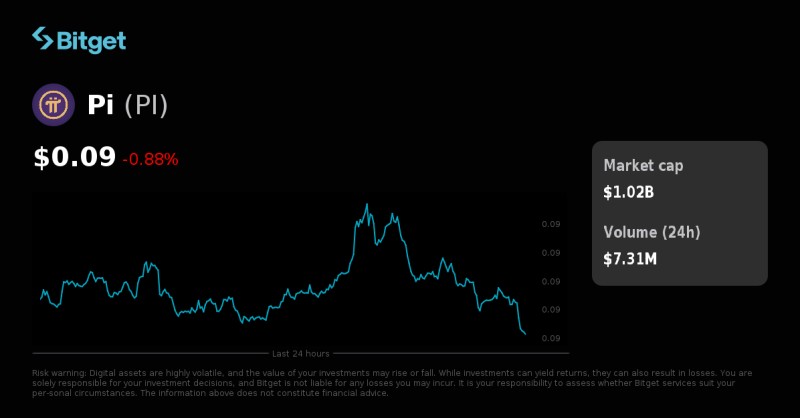
The live price from source data sat at about $0.08 USD. Market cap was near $878 million. Volume was around $30 million in 24 hours. Circulating supply was about 10.94 billion PI out of 100 billion total. All-time high was $2.98, far above the later price.
Support was near $0.08 and resistance near $0.109. RSI was around 43, neutral to bearish. MACD was bearish. Price was below major moving averages. Token unlock pressure added supply in a 30-day window, which can push price down.
Unless the Pi is available to sell, it's not worth anything as far as users are concerned, but if too much is available to sell, it could crash the price.
Utility And Real Use
Pi Browser and Pi Wallet host dApps that need PI for transactions. Without organic demand, the coin risks pump and dump. Peer-to-peer commerce lets people exchange goods for PI, building barter value. PiFest had over 100,000 merchants sign up.
Right now you can buy small items like mugs, t-shirts, electronics, food in the community. Big stores don't accept it yet. The ecosystem had about 70 apps, including Fireside Forum and the KYC tool. Pi Network Ventures puts $100 million in USD and Pi to grow apps.
If you wonder how people make money off crypto with something like Pi, the source says it is through real use and demand, not just holding locked coins. And if you compare to a normal bit coin trade , Pi is still early and less liquid.
Founders View On Value
In an open network video, founders said Pi is different because it never did an ICO, was free to mine, is mobile-first, and has a fully KYC'd mainnet. They emphasize utility over fake tokens. Hard problem is what should be traded: real apps and commerce.
Pi hackathon apps include dating and e-commerce, not just DeFi. Ecosystem tokens are made for user acquisition, not capital raising. Startups lower user cost this way. The goal is tools for growth with user consent, not quick flips.
Challenges And Risks
Lack of transparency is a big one. Deleted updates, rare communication, and a $100M venture fund from a "ownerless" foundation look suspicious to some. They raised $800k but claimed no ICO. Team controls large supply indirectly, and on-chain moves to exchanges were seen.
Supply and demand imbalance is clear. Huge supply waits with team and pioneers ready to sell, but few buyers. Low liquidity makes price easy to pump or dump. Some users keep mining and waiting, thinking "wait longer, I'll be rich." That is a risk.
Main risks to worth
- Opacity and deleted updates
- Team controlled large supply
- Low liquidity enables manipulation
- Many locked coins waiting to sell
The only exception is if you are mining Pi, in which case it's free money. Then again, when something is free, it usually means that you're the product.
Centralization Concern
The blockchain had just 28 nodes and 3 validators, all run by core team per one view. Founders say over 350,000 computing nodes for AI and tens of millions verified humans. Exchanges list decentralized projects more easily, so this centralization may block listings.
No staking rewards at chain level, only mining rewards. The modified Stellar Consensus Protocol is used. Reported speed claims of 70,000 transactions per second seem unlikely given Stellar does a few thousand. Possible only if very centralized, source says.
Scenario Analysis
Bull case: mass merchant use, top exchange listing, "PayPal of Crypto" for unbanked, value stabilizes higher. Bear case: miner dumping beats demand, no killer apps, price drops to fractions of a cent. Base case: long consolidation, supply absorbed by loyal users.
Investor risk includes regulatory scrutiny and global KYC standards. The market was in a bottoming phase with fear sentiment. Medium term could turn neutral to bullish if support holds and utility grows. But that is not guaranteed.
Possible outcomes
- Bull: adoption and big listings lift price
- Bear: dumping drops price to near zero
- Base: slow consolidation, modest cap
- Risk: rules and unlock pressure hurt
Where People Trade Or Buy
Pi listed on Bitget and others with PI/USDT spot trading. Fees can be low. Bitget claims 120M+ users and a protection fund, but that is exchange context, not Pi itself. For a user new to this, how to buy cheap crypto often means compare fees and liquidity before you act.
Some wonder where to buy ripple coin or best crypto to buy on robinhood when they start. Pi is not always on those venues. And tokocrypto exchange is one of many places people ask about, though source only names Bitget for Pi spot.
If you look at cryptocurrency luno or buy cryptocurrency using paypal , those are separate rails. The source does not say Pi is there. Always check if the coin is truly tradable and not just an IOU.
Availability to sell is key; earned but locked Pi is not worth anything to users until migrated and tradable.
User Adoption Numbers
Pi had 55 million active Pioneers per one source. Over 14 to 17 million passed KYC. Founders say tens of millions verified. Pi Day, hackathons, and local commerce events build community. Free mining with no upfront cost separates it from scams in their view.
Community rewards distribute over time. Lockups earn higher mining. The source says Pi states it has the largest number of verified users of any crypto project. Most pioneers just log in to mine and check unlocks, though.
Doing KYC Step By Step
To complete KYC: install Pi Browser, create wallet, tap KYC icon, upload ID, face verify, pay small fee (usually 1 Pi). Then move coins to mainnet wallet. This is needed before coins count as real spendable value.
The source notes Nicholas said in April 2021 all transaction fees would be burned, but that is not the case now. Pi is used to pay fees, as payment in apps, and for ads. Ecosystem tokens aim for user acquisition, not capital raising.
KYC steps
- Install Pi Browser
- Create wallet and tap KYC
- Upload ID and do face check
- Pay small fee then migrate
Video Review Notes
A video titled "Pi Network: You Won't Believe This! Review, History & Potential" dug into history and potential. It calls Pi controversial, a mix of Worldcoin and Notcoin, with limited potential unless mining stays free. The free angle is the only real edge.
The video says Pi could rally high due to low liquidity, but depends on manipulation and milestones. Roadmap items include migrating more Pi, converting Fireside tokens, better developer onboarding. Communication issues remain as team posts rarely.
When something is free, it usually means that you're the product.
Future Focus And AI Plans
Future focus is more apps and utility, digital identity, interoperability, better UX. KYC as service and AI infrastructure are goals. Pi App Studio uses AI to help build apps. Pi Network Ventures invests in vetted teams with USD and Pi.
Long term, they want distributed AI training using 350,000+ nodes and verified humans. That could add fundamental value if it works. But the source shows it is still a plan, not a proven market yet.
If you ask how to buy crypto token in this ecosystem, the answer is wait for open trading and use listed venues. And where to buy pixel crypto is a different asset class, but the same caution applies: real liquidity matters more than hype.
My Take On The Core Question
So is pi crypto worth anything? In my read of the source, the answer is conditional. It has worth only when freely tradable and demanded. Earned but locked Pi is not worth anything to users until migrated and tradable.
The project has real users and a big KYC base. But centralization, opacity, and huge waiting supply are heavy weights. Until coins sell open, price is a guess, not a fact of use.
What I watch for
- Open trading with real volume
- Merchant use beyond community
- Top exchange listings
- Unlocks not crashing price
Supply Pressure And User Traps
The team adjusts migration conditions to manipulate available supply. Raising requirements reduces available Pi. This may keep pioneers using the app with hopes of riches. That is a soft trap, not a scam claim, just a noted risk.
Earned Pi vs available Pi is the split that decides felt value. If none is available, users feel broke. If too much is available, price may crash. The balance is fragile in low liquidity.
Team adjusts migration conditions to manipulate available supply.
Global Price Snapshot
Source gave prices in many currencies for Pi. USD was about $0.08, EUR near €0.07, GBP £0.06, JPY ¥13, INR ₹7.69, CNY ¥0.54, RUB ₽6.15, BRL R$0.41, ARS $119, CAD C$0.11, SAR ر.س0.3, PKR ₨22.32. These show low nominal value per coin.
For $10 you could get about 124 Pi at that price. Highest 24h was near $0.097, lowest near $0.078. The source tied these to a specific day, but the point stays: Pi trades cheap and swings hard.
Why IOU Is Not Real
Pre-open IOU tokens traded at silly highs over $300. Those were not real on-chain Pi. They were promises on platforms, not spendable coins. Psychological grey market resistance formed around $0.30 to $0.50 later.
This is why is pi crypto worth anything must be split from IOU noise. Real worth needs mainnet coins free to move. Until then, numbers are smoke.
Open Mainnet Milestone
Key dates from source: March 2019 app beta, March 2020 Testnet, Dec 2021 Enclosed Mainnet, then Open Mainnet close to two years after enclosed phase. Created by Stanford PhD grads, with Vincent later leaving.
Open mainnet let external world connect. Some exchanges listed Pi or IOU after. But the source warns not all users could move coins fast due to KYC and migration rules.
What Real Demand Looks Like
Real demand means people buy Pi to use it, not just hold. DApps in Pi Browser need PI for txns. Marketplaces with goods give barter value. Over 100,000 merchants at PiFest is a start, but small vs global trade.
Institutions may like 14M+ KYC users for ads or regulated assets. But they may doubt KYC legit, given a 2021 leak of 10,000 Vietnamese users via third-party KYC. Most pioneers only mine and check unlocks.
Demand signals
- DApp usage with PI fees
- P2P marketplaces for goods
- Merchant signups at events
- Verified user base for trust
Node And Consensus Facts
Pi uses modified Stellar Consensus Protocol, a fork in practice. Trusted nodes and validators run the network. The source saw 28 nodes and 3 validators core-run, which is low for decentralization claims.
Founders say 350,000 computing nodes for AI distributed tasks. That is separate from chain validators. The mix confuses some readers, and I get why. Keep chain nodes and AI nodes as different things.
Final Word On Worth
The ultimate worth is decided by move from mobile app to functional utility on global blockchain. Until coins are freely tradable and demand exists, locked coins have no realized value. That is the plain line from source.
I'd tell any reader: don't treat mined Pi as cash until you can sell it. Watch supply unlocks and real merchant use. The question is pi crypto worth anything has one answer until then: not yet, for most users.
Until coins are freely tradable and demand exists, locked coins have no realized value.



Comments on “What Decides If Pi Crypto Is Worth Anything”
No comments yet. Be the first to share your thoughts.