
A Simple Way to Build a Trading Bot for Robinhood in Python

Build a Trading Bot for Robinhood
I've been poking at the idea of a trading bot for Robinhood for a while. The short version: a small script can watch the market and trade for you. You don't need to be a coder to get started, but some Python helps. I'll walk through what I found in plain words.
Why a Trading Bot for Robinhood Makes Sense
A trading bot for Robinhood lets a little code do the boring work. It checks prices, looks for signals, and can buy or sell without you staring at a screen. The bot uses the Robinhood API to talk to your account. That means it can pull real time ticker info and place orders for you.
The nice part is sleep. You set the rules, the script runs, and you go live your life. For some folks, a trading bot for Robinhood is the only way they stick to a plan instead of panic selling.
Python Libraries You Need
The bot I looked at is written in Python. It leans on two core libs: robin-stocks and ta. robin-stocks talks to the Robinhood API so you can buy, sell, and get ticker data. ta is a tech analysis lib that uses pandas to make indicators from stock data.
Main libs in the simple bot
- robin-stocks for Robinhood API calls
- ta for technical indicators
- pandas for data frames
- numpy for number work
- matplotlib for charts
You also want Python 3 on your machine. The repo I saw used Python 3. Install the libs with pip. That gets you most of the way to a working trading bot for Robinhood.
Gold Cross Strategy in the Bot
The sample bot uses a golden cross strategy. If a stock's 50-day moving average goes above its 200-day average, the bot buys. If the 50-day drops below the 200-day, that's a death cross, and it sells. Simple to read, easy to change.
The code is described as simple to modify. You can plug in new strategies without a rewrite. For a trading bot for Robinhood, that's a big plus because most of us tweak as we learn.
If a stock's 50-day moving average crosses above its 200-day moving average, the bot purchases it.
How the Bot Picks Stocks
Robinhood shows stocks you hold in the portfolio tab. Stocks you watch sit in the watchlist. Every time the script runs, it scans the portfolio for sell signals and the watchlist for buy signals. Then it may place orders.
This keeps the trading bot for Robinhood focused. You tell it what to watch, it does the scan. No need to feed it the whole market unless you want to.
Trade History and Logging
The bot keeps track of trades. It writes the buy price, the date bought and sold, and total gain to a text file as JSON. That file is your paper trail. You can call read_trade_history to print it later.
Whenever the script sells a stock, it considers itself to have completed a trade and writes data about the trade to a text file.
I like this part. A trading bot for Robinhood that hides its work is useless. You need the log to see what went right or wrong.
How to Run the Bot
To run it, install Python 3 and use pip to get robin-stocks, ta, numpy, pandas, and matplotlib. Download the repo, then edit line 10 of main.py with your Robinhood email and password. Then run main.py.
If you want to see crosses without trading, comment out the sell lines and buy lines. That lets you test the logic of your trading bot for Robinhood before real money moves.
Quick run steps
- Install Python 3
- pip install robin_stocks pandas numpy pandas_ta
- Edit login info in main.py
- Run main.py once a day
Code Notes on Moving Averages
A snippet in main.py grabs symbols from portfolio and watchlist into two lists. The golden_cross method pulls a year of history, gets close prices and dates, and makes pandas series. Then ta makes simple moving averages.
Those series go into one data frame. A call to get_last_crossing returns 1 for golden cross, 0 for nothing, and -1 for death cross. That's the brain of this trading bot for Robinhood.
Changing the Strategy Periods
The golden cross is called with periods _n1_ and _n2_ and a lookback days value. You can edit those to use different averages. Want 20 and 50? Change the numbers. The trading bot for Robinhood does not care, it just follows.
If you want other indicators from the ta lib, swap lines 89-90. There are many options. You are not stuck with simple moving averages if they don't fit your style.
Five Year Check Before Buying
The bot adds a five_year_check method. It makes sure a stock has been public or risen over the last five years before buy. The idea: if it hasn't, it may be in decline or just range-bound, and the cross strategy won't work well.
Stocks that don't meet this requirement are either fundamentally on the decline or related to commodities and range-bound, so the golden cross strategy is not very suited for trading them.
Charts and Debug Views
You can comment out lines 94-95 to see price and indicators in matplotlib. The Amazon chart showed a golden cross in late April as one example. Seeing the chart helps you trust the trading bot for Robinhood.

A picture of the cross on a real stock makes the rule click. I'd always look at the chart before I let any script trade my cash.
Scan Stocks Method
scan_stocks walks through the symbols from portfolio and watchlist. It checks for crosses, then calls sell_holdings or buy_holdings, and writes to the log. This is the loop that runs each time you start the trading bot for Robinhood.
The buy and sell methods are basic. Sell dumps all holdings of a stock. Buy tries to spread cash evenly and use extra buying power. You can edit them if you want different behavior.
Python Trading Bot Technical Setup
A more formal guide I read builds a trading bot for Robinhood with the API for program access. It focuses on risk, tech analysis, and system reliability. You need Python 3.8 or newer and a few libs.
Prerequisites from the guide
- Python 3.8+ dev env
- robin_stocks library
- pandas_ta for indicators
- numpy for math
- pandas for data work
- Robinhood account with API access
- Two-factor auth turned on
- Trading permissions set
The guide uses a venv. You make it, activate it, then pip install the deps. Clean and keeps your system tidy while you build a trading bot for Robinhood.
Authentication With Robinhood API
Auth is a small function. It calls rh.login with your user and password, sets expiresIn, and uses by_sms for two-factor. If it fails, it raises an error. That's your gate before the trading bot for Robinhood does anything.
rh.login(username=username, password=password, expiresIn=86400, by_sms=True)
Risk Management Code
The guide has a RiskManager class. You set max position size and max daily loss. It checks a trade against those limits before you place it. This is the part most new traders skip, and it bites them.
For a trading bot for Robinhood, risk code is not optional. A bot with no stop will happily lose your rent. The class keeps a daily P/L and says no if you breach the cap.
Market Data Collection
get_market_data pulls stock historicals from the API. You pick interval and span, like 5 minute and day. If it fails, it logs and returns none. The trading bot for Robinhood needs this to make choices.
Cache the data if you can. Robinhood API allows about one request per second. Hit it too fast and you get blocked. Slow and steady wins here.
Trading Strategy Class
TradingStrategy takes a list of symbols and indicator settings. It loops the symbols, checks buy and sell rules, and returns BUY or SELL. This is where your brain meets the trading bot for Robinhood.
What the strategy does
- Loops each symbol you watch
- Checks buy conditions
- Checks sell conditions
- Returns signal per stock
Risk Rules to Live By
Across guides, the same rules show up. Max 2% risk per trade. Scale size by volatility. Use hard, trailing, or ATR stops. A trading bot for Robinhood should respect these or you will get hurt.
Test thoroughly in paper trading or simulation mode before real capital. Start with small position sizes.
One guide says max 2% per stock and 8% stop that tightens to 3% after 15% gain. Never more than 5% in one stock or 25% in a sector. Good guardrails for any trading bot for Robinhood.
Monitoring and Reports
A TradingMonitor class logs trades and tracks metrics. It can report total trades, win rate, and profit factor. You want this view so your trading bot for Robinhood is not a black box.
The log should be plain. Date, symbol, buy, sell, gain. Read it weekly. The bot can be dumb, you are the one who learns from the printout.
API Rate Limits and Safety
Robinhood API allows max one call per second. Use exponential backoff if you get errors. Cache data you use a lot. A trading bot for Robinhood that ignores this gets banned fast.
Turn on two-factor auth. Set trading permissions right. These are boring steps but they keep your account from being a mess while the script runs.
Error Handling for Orders
safe_execute_order wraps the buy or sell call in try and except. If it fails, it logs and returns none. You don't want a crash to stop your trading bot for Robinhood mid-trade.
If side == 'BUY': order = rh.orders.order_buy_market(symbol, quantity)
Iron Condor Options Bot
One write-up builds an iron condor options trading bot in Python and Jupyter. The iron condor uses four option contracts at once: long put, short put, short call, long call. It aims to profit when the stock barely moves.
The best time to run this is 30 to 45 days from expiration, to use time decay. It fits range-bound stocks. A trading bot for Robinhood can place these orders if you wire up the option calls.
This is more advanced than stocks. But if you like options, a trading bot for Robinhood that handles iron condors saves you from manual ticket entry.
No-Code Robinhood Automation
Not everyone wants to code. A trading bot website like Coinrule can automate Robinhood without Python. You connect via API, your funds stay at Robinhood, and you set rules like RSI below 30 to buy.
For folks who'd rather click than code, this is a real path. The trading bot for Robinhood becomes a set of toggles. You pick the trigger, it places the order. Some people find that calmer than a repo.
a trading bot websiteCoinrule Platform for Robinhood
Coinrule links to Robinhood through secure API. It runs on equities and ETFs. You set rules like price drop over 5% to buy AAPL or TSLA. They report 410k+ users and 2.1M+ auto executions.

The platform has DCA and rebalance templates. It splits a monthly sum into weekly buys of VOO or QQQ. A trading bot for Robinhood via Coinrule can do this while you sleep.
Coinrule risk controls
- Stop-loss on every strategy
- Max 2% size per stock
- 8% stop, tightens to 3% after 15% gain
- Daily loss limit pauses bots
Ready Made Automation Templates
Coinrule ships templates you can use as-is. Buy the Dips buys on a 3-7% drop. DCA Accumulator splits monthly cash to weekly buys. Momentum Pullback buys on pulls to the 20-day line.
Sample templates
- Buy the Dips: buy on 3-7% drop, exit at 10% gain
- DCA Accumulator: weekly buys no matter the price
- Momentum Pullback: buy on pull to 20-day MA
- Dividend ETF Seasonality: buy before ex-dividend
- Support and Resistance Bounce: buy bounces, tight stop
- Sector Momentum Switcher: rotate by relative strength
- Earnings Drift Rider: hold 30-60 days post surprise
- Low Vol Defensive Rotation: shift when VIX high
- Portfolio Rebalance: keep target weights
- RSI Oversold Rebound: buy RSI below 30
These are good starts for a trading bot for Robinhood if you don't want to write the logic. Pick one, test it, then tweak the numbers.
Backtesting and Alerts
Coinrule lets you backtest rules on old price data. You see how DCA did in past volatility. Mobile alerts tell you when a rule fires. That feedback loop helps a trading bot for Robinhood stay honest.
You can start in paper mode. Test the rule, watch the alerts, then switch to real cash slow. I'd never flip a bot to live without a test run.
TradersPost Automated Trading
TradersPost is another trading bot website for stocks, crypto, options, and futures. It ties to TradingView and TrendSpider. You build a strategy, link Robinhood, and fire webhooks to trade.
They report $550M+ in linked accounts and 70k+ traders. Free trial, paper account, and a 3 minute setup. A trading bot for Robinhood through TradersPost means less code for you.
trading bot website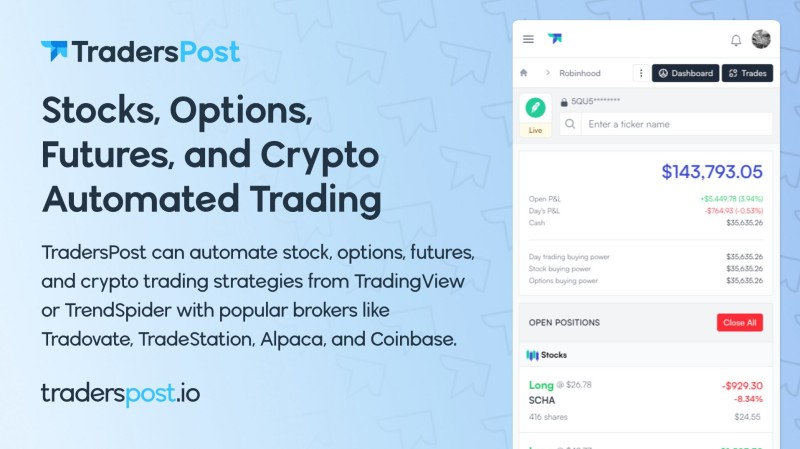
Signal JSON tells it ticker, action, quantity, and stops. It routes to many brokers at once. If you run more than Robinhood, this kind of trading bot for Robinhood bridge is handy.
How TradersPost Works
Step one: make a strategy with entry, exit, stop, and size. Step two: link broker accounts in seconds. Step three: send a webhook and orders fill across accounts. The trading bot for Robinhood part is just one link.
TradersPost steps
- Create strategy with stops and size
- Connect Robinhood and other brokers
- Send webhook from TradingView
- Track fills and P&L in real time
It supports stocks, options, futures, and crypto. Many brokers connect. A trading bot for Robinhood can sit next to Alpaca or Interactive Brokers in one view.
Best Trading Bot Strategies
The source lists a bunch of plans. Golden cross for stocks. Iron condor for range options. DCA for slow build. RSI oversold for rebounds. The best trading bot strategies are the ones you understand and test.
best trading bot strategiesDon't copy a plan blind. A trading bot for Robinhood with a strategy you don't get will confuse you when it loses. Learn the rule, then run it small.
Automated Trading Bots Free Options
Some paths cost nothing to try. The Python repo is free. TradersPost has a free trial and paper account. Coinrule has a simulation mode. Automated trading bots free to test are the right first step.
automated trading bots freeUse the free mode to learn the feel of a trading bot for Robinhood. You can always pay later if the tool saves you time or bad trades.
Crypto Bots and Robinhood Context
Some platforms also touch crypto. A trading crypto bot on another app is not the same as a trading bot for Robinhood stocks, but the ideas cross over. Same API care, same risk rules, same log need.
trading crypto botIf you run a trading crypto bot elsewhere, the lessons help here. Watch rate limits, use stops, and keep the trade file. Robinhood is just one more link in the chain.
AI Trading Bots Reviews
You'll see ai trading bots reviews for many tools. Most talk about ease, cost, and if the bot follows the rule. For a trading bot for Robinhood, read if it keeps funds at the broker and uses the official API.
ai trading bots reviewsI take those reviews with a grain of salt. A bot that looks smart can still lose money in a dull market. The review helps pick the tool, not the trade.
3Commas and Other Bots
Folks ask about 3commas trading bot and 3commas trading bot review numbers. Those tools often focus on crypto, not Robinhood stock. But the 3commas trading bot review talk shows what people want: easy rules and clear logs.
3commas trading bot 3commas trading bot reviewA trading bot for Robinhood can learn from that. Keep the UI simple, show the trade history, and don't hide the stops. That's what users beg for in every review.
Best Trading Bot Crypto and Crypto Trade Context
The best trading bot crypto talk is loud online. It matters here only as a compare point. A trading bot for Robinhood is stocks and ETFs, not coins, but the trade logic is kin. Set rule, check risk, log it.
best trading bot cryptoIf you trades binance in the past, you know the API drill. The trading bot for Robinhood uses the same shape: auth, pull data, place order, write log. Different venue, same bones.
trades binanceBest Way to Trade Crypto Note
Some ask the best way to trade crypto when they mean any auto tool. For stocks on Robinhood, the best way to trade crypto lesson is: don't rush, use paper, and size small. A trading bot for Robinhood should echo that.
best way to trade cryptoThe tool is not the win. The plan is. I'd rather run a dull trading bot for Robinhood that logs every move than a flashy one I can't read.
Unified Risk and Ops Basics
Pulling it together, the guides agree. Max 2% risk per trade. Volatility sized. Hard or trailing stops. Paper test first. Small size, then scale to 3-5%. A trading bot for Robinhood needs these bones.
Ops basics to keep
- One API call per second max
- Exponential backoff on error
- Two-factor on Robinhood
- Paper trade before real cash
- Logs on every trade
That's the whole safety net. Skip one and the trading bot for Robinhood can drift. The market does not care how smart your code looked on day one.
Options Timing Detail
For iron condor, run 30-45 days from expiration. Expect small moves. For golden cross, run once a day with 50 and 200 day lines. You can change periods and lookback. The trading bot for Robinhood should match the plan.
I'd set a calendar reminder to check the bot after big news. Auto does not mean absent. A trading bot for Robinhood still needs a human glance now and then.
My Take on Starting Small
If you build the Python bot, start with one stock in the watchlist. Let it run in comment-only mode for a week. Read the log. Then let it trade tiny. A trading bot for Robinhood is a tool, not a miracle.
The no-code paths are fine if code stresses you out. Coinrule or TradersPost can be your trading bot for Robinhood with less setup. Pick the path that gets you to a test fast, then learn from the printout.


Comments on “A Simple Way to Build a Trading Bot for Robinhood in Python”
No comments yet. Be the first to share your thoughts.