Best Crypto Trading Platforms: How to Compare Fees, Spreads, Security, and Tools
No Single Best Crypto Trading Platform
There is no single best trading platform for crypto. Security and transparency should be compared alongside the reliability of order handling, fees, spreads, liquidity, available markets, and trading tools. The platform that fits a beginner buying spot crypto may not suit an active scalper, an options trader, or a developer building automated strategies. If you want the crypto exchange best for your situation, you need to compare what actually matters instead of chasing marketing claims.
There's no single best trading platform for crypto. Check security and transparency first, along with how reliably the exchange handles orders.
Security and Transparency
A security comparison should distinguish between controls protecting the platform and controls protecting an individual account. Account-level protections include two-factor authentication, passkeys or hardware security keys, withdrawal address allowlisting, anti-phishing codes, login and device alerts, clear account-recovery procedures, and security settings that are straightforward to enable and maintain.
Platform-level signals include cold-storage practices, hot-wallet controls, multi-signature systems, custody segregation and architecture disclosures, encryption at rest, controlled access to systems and operational keys, physical infrastructure protections, ongoing security testing, incident-response readiness, proof-of-reserves and proof-of-liabilities where available, public cold-wallet addresses for on-chain verification, ISO and SOC certifications, and public security documentation.
Certifications and audits are trust signals, but they do not guarantee absolute safety. Platform size alone does not protect an account that uses a weak password, lacks two-factor authentication, or ignores phishing risks. A platform can also be secure while still being unsuitable for a particular user because of regional restrictions, product availability, fees, complexity, or custody preferences.
Order Execution, Liquidity, and Technical Reliability
Scalping depends on entering and exiting quickly at the intended price. A platform should be evaluated for order-book depth and liquidity, bid-ask spreads, slippage, reliability of limit and stop orders, speed of market/limit/stop/conditional orders, platform stability during volatile periods, ability to use charting and indicators and algorithms and bots, availability of spot/margin/futures/options markets, and counterparty and custodial arrangements.
One untriggered stop order during a platform failure can offset months of scalping profits. A large order book can reduce slippage, but order types must also execute as intended.
Fees and Spreads
High-frequency strategies require particularly close attention to costs. The relevant measures include maker fees, taker fees, fees on stop-market or stop-limit orders, bid-ask spreads, slippage on market orders, deposit or withdrawal fees, discounts tied to platform tokens or trading volume or referrals, and separate fee schedules for spot and derivatives.
A low headline maker fee may be less important if taker fees, spread costs, or slippage are high. A platform with equal maker and taker fees may be useful for scalpers who rely on market orders and market stops.
Tools and Workflow
Depending on the strategy, relevant tools can include spot and derivatives order types, options Greeks and implied-volatility charts, demo/testnet/paper-trading/backtesting environments, TradingView charts, custom indicators, MetaTrader 4 integration, expert advisers and algorithmic strategies, copy trading, grid and shadow-grid tools, trading bots, APIs and command-line interfaces, Model Context Protocol servers, AI-agent integrations, smart order routing, and portfolio/position/account-management interfaces.
Customer Support, Privacy, and Regional Availability
Support should be evaluated for responsiveness, available languages, and the ability to resolve problems involving deposits, withdrawals, order execution, and account access. KYC requirements vary by platform, product, jurisdiction, and account feature. A platform described as not requiring KYC for ordinary trading in one period may later change that policy or require KYC for features such as copy trading.
Users should also verify whether the platform accepts customers from their jurisdiction, which legal entity serves the account, what licenses or registrations apply, whether the exchange is centralized/decentralized/hybrid, whether available products are restricted locally, and whether local law prohibits trading even if a platform technically permits it. The rule stated in the Bybit material is direct: do not trade on an exchange that prohibits trading from the user's geographical region.
Do not trade on any exchange that prohibits trading from your geographical region.
Spot Trading
Spot trading purchases or sells cryptocurrency at the current market price. It is commonly described as the simplest form of crypto trading because it does not involve leverage. Profits depend primarily on the price appreciation of the asset. Spot suits beginners and long-term investors who do not want to borrow funds or manage leveraged positions. A spot platform should be compared on supported assets, deposit methods, fees, spread, withdrawal reliability, security, and custody model.
Margin Trading
Margin trading allows a trader to borrow money to increase a position. Leverage increases both potential gains and potential losses. Margin trading requires market knowledge and active risk management. It can produce losses exceeding the initial investment and may require additional collateral or liquidation if the position moves against the trader. A margin platform should be evaluated on borrowing costs, available collateral, liquidation rules, supported pairs, leverage limits, order handling, and the ease of transferring or reducing collateral.
Futures and Derivatives
Futures and derivatives derive their value from an underlying cryptocurrency rather than requiring ownership of the asset. They permit long and short positions and can be used to speculate on price or hedge volatility. Futures carry leverage and liquidation risk. A sudden market move can erase collateral or create losses larger than the amount deposited. Perpetual futures, coin-margined futures, USDT-margined futures, and USDC-margined futures have different collateral and liquidation mechanics.
Bitcoin and Crypto Options
Bitcoin options are crypto-derivative contracts that give a trader the right, but not the obligation, to buy or sell Bitcoin at a predetermined price before a specified expiration date. Calls represent the right to buy; puts represent the right to sell. A call buyer pays a premium and has a conditional long position. The maximum loss on the long option is ordinarily the premium paid. A put buyer also pays a premium and has a conditional short position. The premium is lost if the option expires without the desired exercise condition.
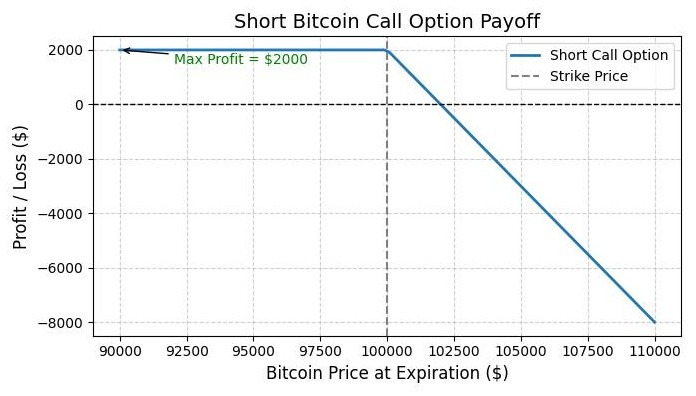
Option sellers receive the premium but take on an obligation. A short call has limited upside and potentially unlimited loss if Bitcoin rises sharply. A short put keeps the premium if the market remains above the strike but can incur substantial losses if Bitcoin falls far below it. These asymmetric positions make risk management important even when the seller's maximum profit is limited to the premium.
Options Example: $100,000 Call, Three-Month Expiration
Consider a Bitcoin call with a $100,000 strike price that expires in three months. The call buyer pays a $2,000 premium to the seller or market maker. The buyer has the right, but not the obligation, to buy one BTC at $100,000 if Bitcoin is above the strike at expiration. If Bitcoin makes a large upward move, the payoff can exceed three to four times the initial premium, particularly if BTC finishes well above $100,000. If Bitcoin does not rally enough for the position to be profitable, the buyer can lose the full $2,000 premium, which is retained by the seller.
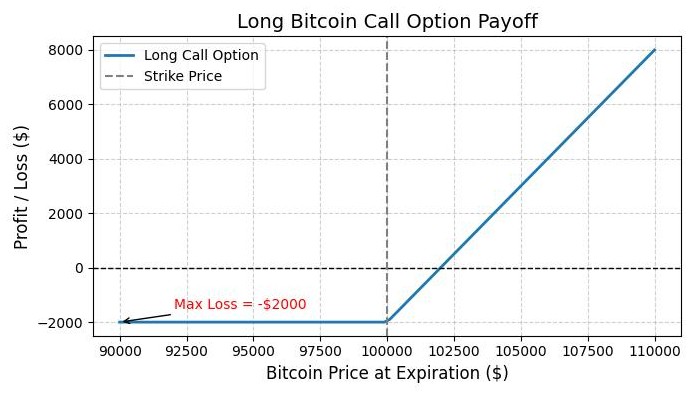
Reasons given for buying the call include taking a leveraged directional position or hedging the upside risk on an existing short futures position. The surrounding explanation presents options as providing leverage without the liquidation mechanism associated with leveraged futures or margin.
Selling a $100,000 Call
The short call has the mirror-image payoff. The seller's maximum profit is the $2,000 premium if the option expires worthless. If Bitcoin rises substantially, the seller may be obligated to sell at $100,000 while the market is higher, creating potentially unlimited loss. Reasons given for selling a call include selling options that the trader regards as overpriced while hedging the exposure, holding Bitcoin spot and earning a yield through a covered call strategy, and generating income from an existing long spot position while accepting an upside obligation.
Options Example: $80,000 Put, Three-Month Expiration
Consider a Bitcoin put with an $80,000 strike price that expires in three months. The put buyer pays a $1,400 premium to the seller or market maker. The buyer has the right, but not the obligation, to sell one BTC at $80,000 if Bitcoin is below the strike at expiration. If Bitcoin falls strongly, the payoff can exceed three to four times the initial premium, particularly if BTC ends substantially below $80,000. If Bitcoin remains above $80,000 through expiration, the buyer can lose the full $1,400 premium, which is retained by the seller.
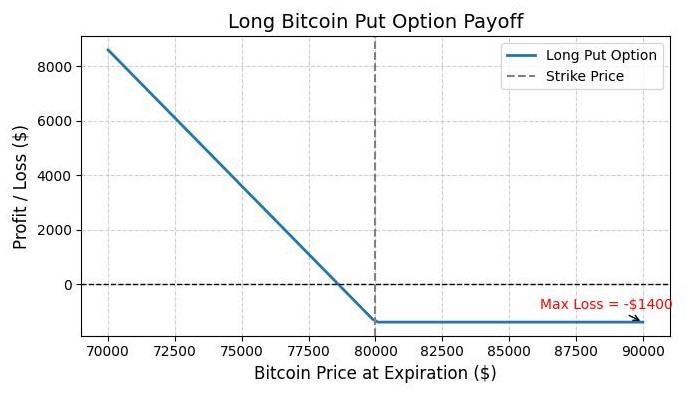
Reasons given for buying a put include taking a leveraged bearish position, hedging downside risk on a long Bitcoin futures position, and hedging downside risk on a long spot position.
Selling an $80,000 Put
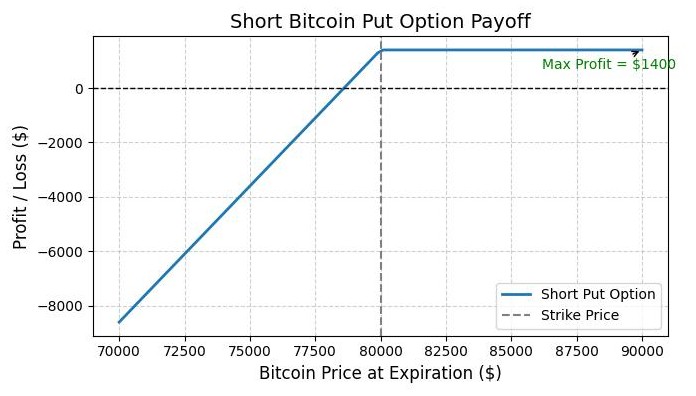
The short put seller receives the $1,400 premium upfront. If Bitcoin stays above $80,000, the seller keeps the premium. If Bitcoin falls sharply below the strike, the seller may be obligated to buy at $80,000 while the market is trading lower, creating losses that can increase sharply. Reasons given for selling a put include taking a leveraged position based on a directional view that Bitcoin will fall, and using a cash-secured-put strategy in which the seller holds $80,000 in cash and is willing to buy BTC at that price if it falls to that level. If the price does not reach the strike, the strategy earns yield on the cash position.
Why Trade Crypto Options
The options material identifies several potential uses: obtaining leveraged Bitcoin exposure with less capital than would be required for a corresponding spot position, protecting a crypto portfolio from downside risk with puts, generating income from an existing spot position through covered calls, using strategies such as vertical spreads/covered calls/iron condors, trading volatility and time decay rather than only directional price changes, and combining long and short positions into structured strategies. Option pricing is affected by volatility, time to expiration, and expected market direction. Risk controls include limiting the portion of a portfolio committed to one trade, using stop-loss orders where appropriate, and monitoring market news, social media, and technical analysis.
Platforms Reviewed for Crypto Options
A March 2025 article by John examined three options platforms and their demo environments. Bybit was described as a prominent crypto-derivatives platform with a strong focus on Bitcoin options, suitable for both beginners and experienced traders. Features noted included a demo trading environment, options margined in both USDT and USDC, a clean accessible interface, a feature-rich derivatives environment, and support for experimenting with strategies before using real capital.
Deribit was described as a pioneering Bitcoin-options platform and a longstanding choice among professional traders. It offered options on Bitcoin and Ethereum, strong liquidity, competitive fees, options Greeks, implied-volatility charts, advanced tools for in-depth analysis, and a dedicated testnet for practicing without financial risk. The testnet was presented as useful for learning the interface and testing strategies before moving to a live account.
OKX was described as an established exchange combining usability with professional-grade features. Features included Bitcoin options, an intuitive interface, deep liquidity, support for multiple trading strategies, risk-management features, European-style options suited to structured expiration-based strategies, and a demo mode for testing approaches without risking real capital. Demo accounts on Bybit, Deribit, and OKX can be used to test options strategies in real-time market conditions.
Demo accounts on Bybit, Deribit, and OKX can be used to test options strategies in real-time market conditions.
Scalping Platforms, Fees, Spreads, and Execution
Scalping seeks relatively small profits or losses over short periods. A high trade count makes execution quality and fees especially important. A good crypto scalping platform should allow a trader to execute trades quickly, enter near the intended price, receive reliable limit-order fills, have stop orders trigger when specified, access enough liquidity to enter and exit without excessive slippage, keep spreads and maker-taker costs low, and remain stable during fast market moves.
The source material states that large exchanges are generally more suitable for scalping because their order books contain more liquidity. Smaller exchanges can offer no-KYC access or listings for smaller altcoins, but thin books can create execution bottlenecks. A May 2022 AltcoinTrading.net list reported that Bitforex printed or copied order-book volume from larger exchanges. That claim was specific to the dated discussion and should not be treated as a current assessment.
Historical 2022 FTX Scalping Assessment
FTX was listed first in the 2022 comparison. At that time, the source described it as offering perpetual contracts for most supported assets, volatility contracts that allowed traders to hedge volatility without having to speculate only on direction, faster and more reliable trading conditions, spot and derivatives markets, scalping bots through Coinrule, and a native automation tool called Quant Zone for running a shadow grid without conventional technical analysis. The stated fee structure for new FTX accounts was 0.02% maker, 0.07% taker, a 5% referral-code discount, and additional exchange-token discounts. FTT fee discounts began once an account held more than $100 of the exchange token, and volume discounts began at 2 MM of traded volume. These figures and products were specific to the 2022 article and should not be assumed to remain available.
Historical 2022 Binance Scalping Assessment
Binance was described as the world's largest cryptocurrency exchange at the time. Its appeal for scalpers included liquidity, a broad market, and one interface for trading, staking, and yield products. The dated fee information stated standard maker and taker fees of 0.1% for new accounts, a 0.075% fee when paid in BNB, a 25% BNB fee discount that was scheduled to expire in July 2022, volume discounts after more than 1 MM BUSD in trading volume, and fee discounts for accounts holding at least 25 BNB. Binance charged the same maker and taker rate, which the source considered useful when using market stops and market orders because the fee did not increase substantially to remove liquidity. The article noted that slippage losses could still occur. Scalping bots for Binance were available through Coinrule.
Historical 2022 Bitfinex Scalping Assessment
Bitfinex was presented as an alternative for traders who valued order-book liquidity and wanted to scalp Bitcoin, Ethereum, Solana, Monero, Litecoin, and other digital assets. The source attributed lower slippage to Bitfinex's order books and listed these historical fee details: no KYC for most markets at that time, a 6% fee discount through the cited referral link, 0.1% maker and 0.2% taker fees for new spot accounts, 0.2% stop-market taker fees for new spot accounts, and 0.02% maker and 0.065% taker fees in derivatives markets. The article said derivatives fees were more suitable for scalpers than spot fees. It also described top-tier order-book liquidity, quick listings for new assets, and prompt delisting when liquidity declined. Scalping bots for Bitfinex were available through Coinrule. The no-KYC policy, fee schedule, available pairs, and delisting conditions were described in May 2022 and are historical.
Grid, Shadow-Grid, and Arbitrage Trading
Grid trading places buy and sell orders at regular price intervals above and below a predefined base price. It seeks to capture normal price fluctuations. Shadow-grid approaches are similar automation techniques. The source associates these methods primarily with foreign-exchange markets but notes that they can also be used on crypto exchanges. The method requires predefined spacing, position limits, money management, and stop-loss controls. It does not remove the possibility of loss when prices move outside the grid or trend strongly in one direction.
Arbitrage seeks price differences for the same asset across different markets. The strategy requires rapid execution, accurate logistics, and low transaction costs. A 2025 guide described arbitrage as a relatively low-risk strategy when high-speed execution is available, while the 2022 scalping article noted that managing the logistics can be difficult and questioned whether a bot would generate a life-changing amount. An arbitrage bot can automate buying and selling when price discrepancies appear, but opportunities can disappear before orders are completed. Exchange-transfer times, fees, market depth, and price movement between markets affect the result.
Swing Trading and Dollar-Cost Averaging
Swing trading holds positions for longer periods than scalping or day trading. The 2022 source described it as a strategy that can capture gains over days or weeks and relies primarily on technical analysis. The article said swing positions can be taken in both bull and bear markets, but actual results depend on the strategy and market movement.
Dollar-cost averaging invests a fixed dollar amount at fixed intervals regardless of the asset's price. It buys more units when the price is lower and fewer when the price is higher, which can reduce the average purchase price and reduce the effect of volatility on entry timing. Buy-and-hold removes the need to time individual purchases and exits but leaves the investor exposed to market declines. Both approaches require a reason for expecting the asset to remain valuable over the intended holding period.
Security-Focused Exchange Comparison
A March 2026 Phemex article by Jessica compared exchanges using security rather than trading volume, fees, or number of products. The ranking used account-security features, custody and platform-security disclosures, proof-of-reserves and transparency practices, certifications/audits/compliance signals, security education and usability, availability in the user's region, and whether the user will actually enable the available protections. The article ranked Phemex first for global security, Kraken for security-documentation depth and infrastructure, Coinbase for mainstream U.S. retail security controls, Gemini for compliance and audit-oriented messaging, and Binance below the first four under the specific security framework used.
These are the assessments in that dated comparison, not a claim that one platform is secure for every user or every jurisdiction.
Phemex Security Details
The 2026 security material described Phemex as the best overall global security choice in its comparison because it combined several protection layers. Account controls included two-factor authentication required for important actions such as withdrawals and adding new addresses, passkey authentication, withdrawal-address whitelisting, anti-phishing codes, additional withdrawal delays for newly added whitelist addresses, and security guidance for account hardening. Transparency measures included proof-of-reserves and proof-of-liabilities framing, a stated 24/7 proof-of-reserves and proof-of-liabilities offering, public cold-wallet addresses for on-chain verification, a dedicated Security & Proof of Reserves help-center section, and educational content about withdrawal controls and account protection. The source classified Phemex as suitable for global users who wanted modern account controls and verifiability. It noted that some U.S. residents could have difficulty accessing the service.
The Phemex site snapshot also displayed spot trading, margin trading, USDT- and USDC-margined perpetual futures, coin-margined perpetual futures, copy trading, trading bots, mock trading, convert, on-chain spot and derivatives markets, savings, staking, launchpool, lending, and access to stocks and metals through the Phemex TradFi offering. The same snapshot displayed time-sensitive rates that were visible at publication, including up to 15.72% APY on ATOM, up to 9.64% APY for staked ETH with an airdrop, and up to 4.25% APY for staking USDT to receive SUSDE. The product snapshot also included one-click crypto purchase, fiat deposits, credit and debit card purchases, P2P trading, and access to on-chain markets. Availability, rates, and regional permissions can change.
Kraken Security Details
Kraken was highlighted for detailed security disclosures and infrastructure controls. The material cited advanced cold-storage and hot-wallet security approaches, physical security controls around infrastructure, encryption at rest, controlled access, ongoing security testing, proof-of-reserves messaging, ISO/IEC 27001:2022 certification, and completion of a SOC 2 Type 1 examination. The source described Kraken as a strong choice for users who prioritize institutional-style documentation, certifications, and infrastructure controls. It noted that a security-heavy platform may not always provide the simplest experience for beginners. The article also mentioned a Reuters-reported development in March 2026 in which Kraken's banking arm obtained a limited-purpose Federal Reserve payments account. The source explicitly noted that this was institutional trust context rather than a direct exchange security feature.
Coinbase, Gemini, and Binance Security
Coinbase was positioned as a security-oriented retail option for U.S. users. The material cited address allowlisting, two-step verification to activate/deactivate/use the allowlist, two-factor authentication, biometrics, YubiKey support, security documentation for withdrawal and account controls, and a mainstream trust profile and established help-center material. Allowlisting limits sends to saved addresses, which can reduce the risk of sending funds to an address controlled by an attacker after an account compromise. Coinbase Advanced was described as a relevant option for users who want more advanced trading tools while retaining security-focused account protections. The source warned that these tools only help when users enable them and maintain secure devices, phishing awareness, and recovery planning.
Gemini was highlighted for compliance- and audit-oriented security messaging. Its security page was described as using the phrase "trust is our product" and emphasizing SOC-related certification claims. The article also noted earlier Gemini milestones involving SOC 2 reporting. Gemini was presented as a candidate for users who prioritize audit, compliance, and institutional trust signals. The source cautioned that certification claims must still be considered alongside practical account protections, product availability, and platform fit.
Binance was included because of its size and global ecosystem. The source said its security experience can vary by product and account configuration and that the breadth of features increases the importance of user-side configuration. Binance was ranked below Phemex, Kraken, Coinbase, and Gemini in the article's security-first framework because the other exchanges presented more directly visible security narratives. It was still considered relevant for users already active in its ecosystem who are willing to manage security settings carefully. The stated trade-off was ecosystem complexity. Large platforms can provide more tools while also giving users more settings to misconfigure.
Security Choices by User Profile
Security-first beginners should prioritize easy-to-enable two-factor authentication, clear anti-phishing guidance, withdrawal allowlisting, a simple security settings menu, and documentation that explains how each protection works. A protection is useful only if the user enables and maintains it.
Users with large balances should compare custody and security disclosures, proof-of-reserves transparency, proof-of-liabilities if available, hardware-key support, device and login monitoring, recovery processes, withdrawal controls and delayed withdrawals for new addresses. The security comparison considered Phemex, Kraken, Coinbase, and Gemini worth reviewing for large-balance users, although each presented a different combination of documentation, controls, and trust signals.
Frequent traders should compare strong protections that do not disrupt order entry, login and security-key reliability, configurable withdrawal restrictions, clear alerts and account-activity records, low-latency order execution, and protection against accidental or automated liquidation. Verifiability-focused users should compare proof-of-reserves documentation, proof-of-liabilities if offered, public verification resources, public wallet addresses, security help-center depth, and clear explanation of how reserves and liabilities are measured. The 2026 comparison considered Phemex particularly relevant to this profile.
Common security mistakes include confusing brand size with personal account security, leaving two-factor authentication disabled, failing to enable withdrawal allowlisting, ignoring passkeys/security keys/anti-phishing tools, relying only on certifications, failing to check regional availability, and not verifying current security pages after an exchange updates its policies.
Bybit: 2022 Platform View and Specialized Trading Tools
A May 2022 No Nonsense Forex assessment by VP selected Bybit after more than a dozen platforms had been researched and sometimes tested. The reasons given for the selection included large liquidity, a centralized headquarters in Singapore which the author described as a safe jurisdiction, a centralized structure for customer support combined with limited identity verification for ordinary trading at the time, low or competitive fees, smooth crypto deposits, an interface designed to avoid flashing numbers/advertisements/bots/pop-ups/NFT promotions/irrelevant offers, direct trading through MT4, and options/DeFi mining/liquidity-mining products.
The centralized-versus-decentralized argument was that a fully centralized exchange could be targeted by governments or other actors but could also provide a central office, licensing, and support. A fully decentralized service might reduce intermediary control but could make support and dispute resolution more difficult. This was the author's assessment rather than a general security guarantee.
Bybit's standard trading setup was described as requiring only an email address and crypto deposit in 2022, without KYC. The article stressed that users choosing copy trading had to complete KYC for that feature. Customer-service testing was conducted by people from the No Nonsense Forex Discord forum. Bybit received high marks. The source did not characterize its support as identically fast as IG or as white-glove as Blueberry, but it said the testers were impressed for a crypto platform. The article also emphasized English-language support and listed customer-service languages including English, Spanish, Russian, Thai, Vietnamese, Chinese, Japanese, Korean, and Turkish.
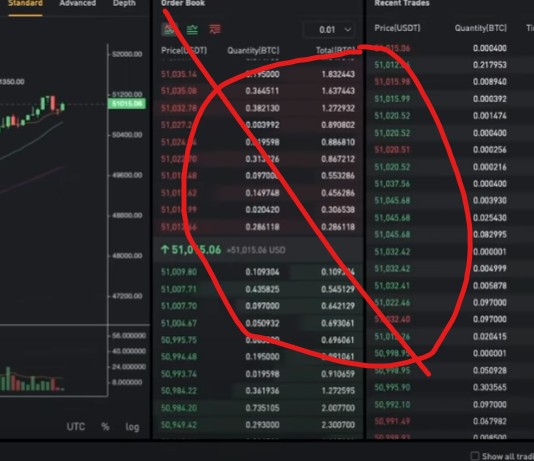
The interface was described as cleaner and less distracting than competing platforms. Price quotes appeared to the side of charts but could be minimized or moved.
Bybit MT4 Integration
The main separator cited in 2022 was MT4 integration. Bybit allowed users to run expert advisers, algorithms, and custom indicators through MetaTrader 4 while accessing Bybit's crypto market. The article stated that users trading through TradingView or MT5 could still use Bybit for entries, exits, stops, and position management. Users who preferred MT4 could execute trades directly through it. The text called the MT4 selection "only 6 pairs," but the list as written contains seven symbols: BTC/USDT, ETH/USDT, XRP/USDT, SAND/USDT, BNB/USDT, LUNA/USDT, and BIT/USDT. The article also said LUNA and UST were being dropped. Bybit's main platform was described as supporting a much larger selection, described as roughly a million pairs, with the author's testers using assets such as Helium and Ravencoin. Bybit's web platform used TradingView charts, but the source said users could not add their own indicators to those charts in the same way they could in MT4.
Bybit Historical Custody, Market, and Account Details
The 2022 article stated that crypto could be purchased directly from Bybit's spot market, XRP was among the available spot assets, deposits had to be made in crypto rather than fiat, users could trade through the main Bybit platform or MT4, Bybit operated as an "A Book" and did not trade against clients, and Bybit offered options, DeFi mining, and liquidity mining.
Bybit Historical Regional Restrictions
The article listed the United States, Singapore, Ontario, and Quebec among banned countries or regions while also stating that some traders from those areas continued to use Bybit. That statement described the author's 2022 experience and does not override local law or current platform restrictions. The article's own warning was: "Do not trade on any exchange that prohibits trading from your geographical region."
Bybit Copy Trading and Promotions
Bybit launched a copy-trading program in spring 2022. Under the described model, skilled traders could publish strategies and receive crypto when users registered to follow them. KYC was required for this route. The dated page also listed US-listed IPO trading, long and short positions on eligible IPOs though not SpaceX, World Cup trading, and a 20% sign-up promotion for first-time users. These were temporary 2022 promotions and product references, not durable platform-selection criteria.
Bitstamp and CoinRoutes Smart Order Routing
A July 2023 Bitstamp announcement described a partnership with CoinRoutes, an algorithmic-trading technology company that had been developing smart order routing since 2017. Smart order routing gives a trader a broader view of liquidity across exchanges and liquidity providers. The objective is to identify available prices and execute on a venue based on factors such as price, volume, available liquidity, and other routing criteria. Bitstamp said the integration gives users access to a wider range of liquidity providers and allows orders to be directed according to market conditions. The partnership was already live and being used by clients at the time of the announcement.
Bitstamp described itself as a secure and reliable platform for a wide range of cryptocurrencies and for both novice and experienced traders. Smart routing is particularly relevant to scalpers and other users whose execution quality depends on liquidity access.
Bitstamp Entities and Regulatory Status
The legal information in the Bitstamp source identifies several entities. Bitstamp Europe S.A. is authorized by the Commission de Surveillance du Secteur Financier in Luxembourg as a payment institution under license Z00000012 and as a crypto-asset service provider under N00000003. Bitstamp UK Ltd. is registered with the Financial Conduct Authority under the Money Laundering Regulations with firm reference number 978690. Bitstamp Ltd. has an address at 5 New Street Square, London, EC4A 3TW. Bitstamp Global Ltd. is registered in the British Virgin Islands as a Virtual Asset Service Provider, supervised by the British Virgin Islands Financial Services Commission. Bitstamp Asia Pte. Ltd. is authorized by the Monetary Authority of Singapore as a major payment institution. Virtual-currency services for U.S. residents are provided by Bitstamp USA, Inc., licensed as a money transmitter by the New York State Department of Financial Services. Derivative investment services are provided by Bitstamp Financial Services Ltd. in Slovenia under Slovenian Securities Market Agency authorization. The source states that derivatives are not available to customers in the United States, Canada, Japan, and some other countries.
Gemini Agentic Trading Through MCP
On April 27, 2026, Gemini announced Agentic Trading, described as the first direct AI-agent integration offered by a regulated U.S. crypto exchange. The feature operates through the Model Context Protocol, an open standard that gives AI agents API access to perform actions for users. Gemini integrated its trading API with MCP, allowing compatible models to work with exchange features. Initial Trading Skills included get Market Data for real-time price information, find the Spread for bid-ask analysis, and retrieve Candles for historical price data. Compatible MCP models named in the source include Anthropic's Claude and OpenAI's ChatGPT. The API was described as supporting basic buy and sell orders as well as complex multi-leg positions.
Gemini stated: "We believe we're at the beginning of a fundamental shift in how people interact with financial markets. Agentic trading isn't just a feature. It's a new paradigm where AI handles the execution, patterns, and discipline, while you focus on strategy and goals." The launch did not eliminate the need for strategy, controls, or user supervision. It changed how an AI model could access market data, analyze spreads, retrieve candles, and submit orders.
The article stated that in February 2026 Gemini planned to reduce its workforce by 25% while streamlining operations. It also said the exchange would leave or abandon businesses in the European Union, United Kingdom, and Australia to focus more heavily on the United States and use AI to operate with a smaller team. Other AI-related financial protocols cited were the x402 protocol incubated by Coinbase and then under the Linux Foundation, which provides AI bots with access to crypto wallets and tools, and the Machine Payments Protocol developed by the Stripe-backed Tempo network, which enables automated machine-to-machine payments.
Alpaca CLI and Agentic API Trading
On April 23, 2026, Luke West announced Alpaca's command-line interface for its Trading API. Alpaca is a multi-asset platform rather than a crypto-only exchange. Its API and CLI cover stocks, options, crypto, market data, order management, positions, and account management. The CLI provides 108 trading functions and offers a terminal interface for the Trading API, explicit commands and typed flags, structured JSON output by default, CSV output and jq-compatible filtering, direct access from a terminal/shell script/cron job/CI pipeline/AI agent, and account/order/market-data/position-management operations.
The CLI and Alpaca's MCP Server V2 provide separate interfaces to the same broader API infrastructure. Installation methods described in the source are go install or brew install. Paper trading allows users to test strategies through the same API without executing real orders or affecting real capital. Live trading requires API keys. The CLI was released as a preview under active development, so breaking changes were expected.
The CLI is generated from Alpaca's public OpenAPI specifications. Commands, flags, type definitions, response schemas, and help text are generated from those specifications. The source states that this process exposed discrepancies in Alpaca's own OpenAPI specification. It also argues that specifications function as interfaces in automated systems because AI tools depend on accurate descriptions, consistent names, and complete type information.
The CLI intentionally omitted several features: no confirmation prompts because it is intended for scripts and agents, minimal client-side validation to avoid rejecting operations the API would allow, JSON-only output rather than maintaining a second human-readable table format, no positional arguments, and no command aliases. The goal was to prioritize interfaces that could be generated automatically and maintained directly from the OpenAPI specification.
CLI vs MCP Server V2
The MCP server runs as a background process for the duration of an agent session. The CLI is a terminal command that executes one operation and exits. An MCP server can expose the full set of tool schemas to the AI model. A CLI command is a short string, so the agent only needs the command required for a focused action. MCP calls are discrete function calls that an AI model can orchestrate. CLI output can be piped directly into shell scripts and other programs. MCP requires an MCP client such as Claude or Cursor. The CLI can run in any terminal, with or without an AI host. MCP calls occur inside an AI session and may be harder to extract or replay. A CLI command is a string that can be logged, saved in a runbook, shared, or repeated.
The source presents MCP as better suited to long-running agent sessions with shared context, while the CLI is better suited to shell scripts, cron jobs, CI pipelines, reproducible runbooks, and focused agent actions.
CLI and Automated-Trading Risks
The CLI preview includes several risks. Paper trading is the default OAuth mode, but live trading uses API keys. API keys should be treated like passwords and never shared. Commands execute immediately. Bulk commands such as cancel-all and close-all do not request confirmation. AI hosts may ask for confirmation, but whitelisting CLI commands can remove that safety layer. An agent with whitelisted order commands can place, cancel, or close trades without human confirmation. Unintended orders can create real financial loss. Market orders can experience slippage, especially in less-liquid symbols or volatile markets. Limit orders can control execution price but may not fill. API rate limits can be triggered by repeated market-data requests or high-frequency order placement.
Additional risks for API and automated trading include market prices/data/other information changing without notice, system-response and account-access times varying with trading volume/market conditions/system performance, automated systems needing continuous monitoring or alerts for connectivity loss/power failure/computer crashes/software faults, algorithms needing monitoring for anomalies that can produce erroneous/missing/duplicated orders, conditional orders depending on trigger processing/market data/internal or external systems, conditional orders not being sent until the condition is met, an outage after a condition is triggered but before execution affecting the order, conditional orders near market close possibly not executing that day, an execution partner imposing controls that prevent erroneous downstream orders, conditional-order execution being on a best-efforts basis after triggering with increased risks similar to stop and market orders, paper accounts helping users become familiar with conditional-order behavior, and margin accounts incurring interest and exposing the customer to losses exceeding deposits or additional-collateral requirements.
Demo Trading, Paper Trading, and Backtesting
Demo and paper trading are presented as risk-control tools across the options, scalping, and API material. A demo account can be used to test an unfamiliar interface, practice order entry, test options strategies, observe scalping conditions, check whether a platform's tools and chart layout fit the user's workflow, test new strategies without immediately risking real funds, backtest ideas in real-time market conditions, and test API commands before live execution. A testnet may not exactly reproduce live liquidity, order fills, fees, or market conditions. The sources recommend using demo accounts on Bybit, Deribit, and OKX, while Alpaca provides a paper-trading API for testing strategies and conditional orders. Demo, testnet, and paper accounts remain subject to their own feature limitations and should not be confused with live execution.
Risk, Legal, and Availability Disclosures
Crypto trading involves the possibility of large, immediate, and permanent loss. Prices can be highly volatile, and risks include market manipulation, flash crashes, cybersecurity failures, system outages, slippage, leverage, liquidation, smart-contract risk, counterparty risk, and changing regulation. Options involve substantial risk and are not suitable for every investor. Short options can create losses larger than the premium received. Margin losses can exceed the initial investment. Algorithmic and AI systems can execute erroneous orders without the hesitation or context a human may apply.
Alpaca Securities LLC is a FINRA and SIPC member brokerage subsidiary of AlpacaDB, Inc. Alpaca Crypto LLC is a FinCEN-registered money services business with NMLS number 2160858 and a wholly owned subsidiary of AlpacaDB, Inc. Alpaca Crypto is not a FINRA or SIPC member. Cryptocurrencies are not stocks and are not protected by FDIC or SIPC insurance.
Bitstamp's derivatives operations are provided through Bitstamp Financial Services Ltd. under Slovenian authorization. Derivatives are unavailable in the United States, Canada, Japan, and some other countries. Customers should identify their contracting entity through their account profile and review the applicable risk warnings, terms, contract specifications, and key-information documents.
For the security comparison, products mentioned in a particular region may not be available to every user. Security controls, documentation, certifications, and account features can change. Current official security pages, fee schedules, product lists, and geographic restrictions should be checked before using any platform.
Key points when choosing a platform
- There is no single best trading platform for crypto - match the platform to your strategy and experience level.
- Security and transparency should be compared alongside order-handling reliability, fees, spreads, liquidity, markets, and tools.
- High-frequency strategies require close attention to maker/taker fees, spreads, slippage, and deposit/withdrawal costs.
- Demo and paper accounts let you test unfamiliar interfaces, options strategies, scalping conditions, and API commands before risking real funds.
- Verify regional availability, legal entity, licenses, and whether local law permits trading before using any platform.
There is no single best trading platform for crypto. Check security and transparency first, along with how reliably the exchange handles orders.
When you are looking for the trading platforms for cryptocurrency , start with what kind of trader you are. A beginner buying spot crypto has different needs than an active scalper or an options trader. The best platform for trading crypto for one person may be a poor fit for another. Compare security and transparency first, then fees, spreads, liquidity, available markets, and the kind of trades you want to make.
If a demo account is offered, use it to test scalping or options before risking real money. A best exchange for crypto is not the one with the most features - it is the one that matches your strategy, risk tolerance, and regional availability. Check whether the platform accepts customers from your jurisdiction, which legal entity serves the account, what licenses or registrations apply, and whether the exchange is centralized, decentralized, or hybrid.
The best place to trade crypto depends on whether you prioritize low fees, strong security disclosures, deep liquidity, or AI/automation tools. For scalping, large exchanges with deep order books generally offer better execution, but thinner books on smaller platforms can create bottlenecks. For options, look for platforms that offer demo environments, options Greeks, implied-volatility charts, and multiple margin options such as USDT and USDC.
If you are in the United States, check exchange crypto usa availability carefully. Some platforms restrict U.S. residents entirely or limit certain products. The rule stated in the Bybit material is direct: do not trade on an exchange that prohibits trading from your geographical region. Verify the current official security pages, fee schedules, product lists, and geographic restrictions before using any platform.
For users exploring specific platforms, an okx trading platform review can be useful but remember that product availability and policies change. OKX was described as an established exchange combining usability with professional-grade features, including Bitcoin options, deep liquidity, and a demo mode. However, a review from one period may not reflect current conditions. The same applies to any cryptocurrency exchanges in usa you are evaluating - check whether the legal entity serving your account has current licenses and whether the available products are restricted locally.
If cost is your main concern, look beyond headline maker fees. A cheapest crypto exchange platform may have low maker fees but high taker fees, wide spreads, or expensive withdrawal costs. A platform with equal maker and taker fees may be useful for scalpers who rely on market orders and market stops because the fee does not increase substantially to remove liquidity. Compare the total cost of your intended strategy, not just the advertised rate.
When evaluating which platform is best for crypto trading , consider the full picture: security controls you can actually enable, order-execution quality during volatile periods, availability of the markets you want to trade, customer support responsiveness, and whether the platform offers tools that match your workflow. A protection is useful only if you enable and maintain it. A platform can be secure while still being unsuitable for a particular user because of regional restrictions, product availability, fees, complexity, or custody preferences.

Comments on “Best Crypto Trading Platforms: How to Compare Fees, Spreads, Security, and Tools”
No comments yet. Be the first to share your thoughts.