
What You Should Know About Investing in Crypto Before You Start

What You Should Know About Investing in Crypto Before You Start
Any investment in crypto can sound as simple as buying a token and waiting. The truth is messier. Bitcoin, stablecoins, digital collectibles, digital tools, crypto assets tied to investment promises, and products that track crypto prices do not carry the same risks or serve the same purpose.
If you are searching for how to invest in cryptocurrencies , do not start with a list of coin names. Start with the asset, the account that holds it, the rules around it, and the loss you can stand. The question is crypto a good investment has no one-word answer. It depends on what you buy, how you buy it, and how much damage a bad turn would do to your plan.
Why Crypto Is High Risk
Crypto assets have set record prices at some points, but they have also seen price crashes, bankruptcies, fraud concerns, and sharp swings. The same asset can move much faster than a bond or savings account and can lose a large part of its value in a short span. That does not prove it is useless. It does mean the buyer needs to understand the loss before chasing the gain.
Main risks named in the source
- Price risk: crypto can rise fast, but it can also fall just as fast.
- Project risk: a company, exchange, or token project can fail or leave investors with losses.
- Fraud risk: fake projects and dishonest promises have remained a major worry.
- Legal and policy risk: the rules for buying, selling, custody, and trading can change.
- Retirement risk: a crypto loss can reduce the money a saver expects to have later.
These risks can feed one another. A weak project may break. A regulator may act. A large holder may sell and push the price down. A fraud case can damage trust in the whole market. None of those things tells you whether crypto has value, but each one matters if you are putting savings into it.
“High-risk, high-reward investments.”
That phrase is too broad to guide a choice. “High reward” is not a promise. It is only the other side of a market that can also deliver a high loss. The source’s warning is blunt: adding crypto to a retirement portfolio could change the amount an investor is able to secure for retirement.
Why Some People Call Crypto an Alternative Investment
Some people place crypto with private equity, hedge funds, and other investments that sit outside the usual mix of stocks and bonds. Others say crypto is not an alternative investment at all because it trades around the clock and can be bought through familiar brokerage apps. An analysis cited in the source looked at seven traits to settle the question. The answer was mixed.
Seven traits used to classify crypto
- Liquidity: crypto can often be bought or sold almost at once, except when a trade is very large.
- Cost: buying and holding can cost little, while private funds and over-the-counter products can charge high fees.
- Complexity: wallets, keys, blockchains, exchanges, and smart contracts can be hard to understand.
- Diversification: crypto has often moved apart from other assets, though it can act like a risk asset during economy shocks.
- Transparency: the Bitcoin blockchain is public, and many blockchain projects use open-source code.
- Novelty: crypto has much less history than stocks, bonds, and many older funds.
- Adoption: some younger investors use crypto more freely, while many older investors have stayed away.
“There is no single definitive answer.”
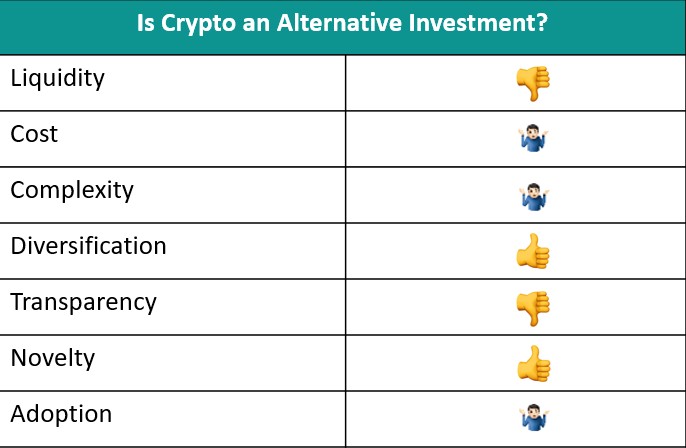
The cited analysis found two traits that supported calling crypto an alternative, two that pushed against that label, and three that did not lead to a firm answer. That matters for beginners because the label will not decide whether an asset fits your savings plan. Liquidity can make crypto easy to trade, but it does not make the price safe. Public code can make a project easier to inspect, but it does not remove fraud or loss risk.
How Crypto Gets Into a 401(k)
Some employer-sponsored 401(k) plans began offering crypto access in 2022. That made crypto easier for workers to reach inside a retirement account, but it did not settle whether the risks belong beside long-term savings. The route matters. A plan may list crypto as a normal investment choice, or it may offer a brokerage window that gives participants access to a wider set of investments.
Two common ways to reach crypto through a plan
- A standard plan option: crypto appears with other investments selected for the plan.
- A self-directed brokerage window: the participant can choose from a wider group of investments, including crypto.
The U.S. Department of Labor oversees employer-sponsored retirement plans. It collects annual information from fiduciaries, which are the people or groups trusted to act for the plan and its participants. That oversight gives workers some protection, but the data does not show the full crypto picture inside every plan.
Outside an employer plan, people also ask about the best Roth IRA for crypto or a self-directed crypto IRA . The source does not compare those accounts or name a winner. It does make one useful point: a choice placed outside a plan’s standard menu may leave more of the watching and risk handling to the participant.
What a Retirement Plan Fiduciary Must Do
A fiduciary must act in the best interests of plan participants. Under the Employee Retirement Income Security Act, or ERISA, that includes looking at the chance of loss as well as the possible gain. A hoped-for price rise does not erase the danger of a large fall. The rule is meant to protect retirement money, not just help the plan look bold.
Duty of a plan fiduciary
- Act in participants’ best interests.
- Consider the risk of loss, not only possible gains.
- Follow the federal standards that protect employee retirement plans.
- Provide annual information about plan investments.
“Extreme care”
Labor officials used that phrase when warning fiduciaries before adding a crypto asset to a plan’s core investment lineup. The warning fits the market’s record: crypto can climb for long stretches and then crash without much warning. It also explains why a plan’s choice to offer crypto deserves the same care given to any other large risk.
Who Must Watch a Crypto Investment
ERISA does not mean a fiduciary selects and monitors every single investment option. Labor officials have generally not required fiduciaries to take on that duty for every choice. A standard plan option and a self-directed brokerage window can therefore sit in very different places when it comes to oversight. That line is easy to miss, but it can decide who has to watch the money.
Different roles for plan crypto
- A standard plan option sits within the investments chosen for the plan.
- A brokerage window may fall outside the fiduciary’s direct selection and monitoring.
- A participant using that window may have the main job of monitoring the crypto investment.
- Annual plan reports still may not show each crypto holding in enough detail.
Hey, don’t skip this part. Before putting crypto into a plan, ask whether it is a standard option or a self-directed choice. Then ask who selected it, who watches it, and what records you can see. If the answer is that the participant is responsible, the work of checking the asset, the account, and the loss belongs to you.
What Retirement Plan Data Leaves Out
The Government Accountability Office has warned that the Labor Department does not collect enough information to fully understand participant investments in 401(k) plans. Some plans with fewer than 100 participants do not have to report the kind of detailed data that would show crypto holdings. Larger plans may report combined figures instead of each investment. The gap can make a small exposure look like none at all.
Gaps in the available retirement data
- Plans with fewer than 100 participants may not have to report detailed investment data.
- Larger plans may combine some holdings into broad totals.
- Combined reports can hide the amount held in crypto.
- The Labor Department may be unable to measure how many plans offer crypto or find plans that need more protection.
“The information collected does not provide a complete picture of crypto investment.”
The GAO has also recommended that Congress consider giving a federal agency clear power to oversee crypto assets. It said that oversight could help fight fraud and market manipulation. The source also says that proposed laws do not replace the need for watchdogs, data, and clear rules. An agency interpretation can explain part of the law, but it cannot do the job of a full system.
How the SEC’s Cited Interpretation Sorts Crypto Assets
The SEC has historically used the Howey test to decide whether an arrangement is an investment contract and therefore a security under federal law. The test asks whether money is tied to an expectation of profit from someone else’s work. Applying it to digital assets has taken case-by-case analysis. The interpretation covered by the source groups assets by what they do and how they are offered and sold.
Five groups in the SEC interpretation
- Digital commodities: assets tied directly to the code-driven operation of a crypto system and supply and demand, rather than profits promised by managers.
- Digital collectibles: items made to be collected or used, such as rights tied to art, music, video, games, cards, characters, or memes.
- Digital tools: assets that do a practical job, such as acting as a membership, ticket, credential, title, or identity badge.
- GENIUS Act stablecoins: payment stablecoins issued by a permitted payment stablecoin issuer are placed in the non-security group.
- Digital securities: financial instruments that fit the law’s definition of a security and are issued or recorded as crypto assets on one or more crypto networks.
This is a functional map, not a promise that every token with a name fits one box forever. The source also notes that the Commodity Futures Trading Commission joined the SEC in issuing the interpretation. Some assets that are not securities may still be commodities under another federal law. The exact rule can depend on what the asset does, how it is sold, and which law applies.
Why the Sale Can Change the Answer
An asset that is not normally a security can still be part of an investment contract. If a buyer is led to expect profits because of work by a project team, the sale may look like an investment contract even when the token itself has another use. The source points to a development team that builds or promotes a project as an example. The token’s label alone does not settle the question.
“The test is flexible, but its application to digital assets has required case-by-case analysis.”
Ways investment-contract status can change
- A non-security asset may be sold in a way that creates an investment contract.
- The investment-contract status may end if the issuer fulfills the promises it made.
- It may also end if the issuer fails to meet those promises.
- An investment contract may continue during later trading of the crypto asset.
Everyday blockchain activities named in the source
- Protocol mining and staking generally are not treated as securities transactions when they help validate transactions and maintain a network.
- Token wrapping, which lets a non-security asset work on another blockchain, generally is not treated as a securities transaction.
- Token airdrops for promotion or network building usually do not involve an “investment of money” under the Howey test.
That list does not turn every mining pool, wrapper, or airdrop into a safe investment. It only says those activities are often treated a certain way under the securities test. The source is clear that the interpretation explains how existing laws can apply; it does not replace legislation. Investors still need to check the facts and the law that applies to their own deal.
The Tech Behind a Crypto Purchase
Crypto can be simple to buy and surprisingly hard to own. The source names wallets, private keys, blockchains, token standards, exchanges, smart contracts, decentralized finance, and other systems that shape the experience. Each term covers a different job. Knowing the words helps, but it does not tell you whether an asset is sound or whether a price will hold.
Terms an investor may need to understand
- Wallets hold or control access to crypto assets.
- Private keys help show control over an address and its assets.
- Blockchains keep records of transactions across a network.
- Exchanges are places where buyers and sellers trade assets.
- Token standards set rules for how tokens work on a network.
- Smart contracts can run code when set conditions are met.
“Caveat emptor.”
That old warning means buyers should look closely at what they are getting. Costs can be reasonable when someone buys and holds, especially with a liquid asset such as bitcoin. Costs can also be high with over-the-counter products or private funds. The spread, fee, and form of custody can matter more to the result than a small difference in price.
So the answer to which cryptocurrency is best to invest in cannot come from one universal list. The asset’s purpose, legal status, cost, custody, and price behavior all matter. Bitcoin’s “digital gold” story and Ethereum’s “programmable money” story can make a complex system easier to talk about. This is where I get skeptical of any promise that a neat story removes the need for facts.
ETFs and Passive Crypto Products
A token and a crypto-linked exchange-traded fund are not the same purchase. The first U.S. bitcoin-linked ETF cited in the source used futures to follow bitcoin’s price instead of owning bitcoin directly. That difference can change the fees, structure, and risks. A passive product can give someone market exposure without picking and holding a token, but it does not remove price risk.
Different ways to gain crypto exposure
- Direct ownership: buy and hold a token through an exchange or wallet.
- A futures-based ETF: track a crypto price through futures rather than owning the token directly.
- An index product: hold a group of crypto assets or products through a fund.
- A self-directed brokerage choice: use a wider investment list inside a retirement plan.
That changes the question. If you buy an ETF linked to bitcoin, you are not picking the crypto coin to invest in yourself, though you still carry bitcoin price risk. If you buy a token and hold it in your own wallet, you take on custody and asset-specific risk.
The source’s analysis also points to trading apps that mix crypto with stocks, funds, and other assets. It says younger investors have been more comfortable treating bitcoin, ether, and stocks as parts of one financial system. That is evidence of adoption, not proof that a purchase is right for every person. A familiar app can make buying easier, but it does not make the underlying asset safer.
Why Crypto Politics Matters to Investors
Crypto rules can change what a project may sell, how a platform may operate, or whether investors have legal protection. When policy can move an asset’s value, politics becomes part of the investment story. That does not make every politician or every lobbying group the same. It does mean a buyer should ask how policy may affect the asset instead of treating regulation as a distant concern.
A commentary by Chris Skinner argued that crypto had moved from being an outside political cause to having much more power inside government. His summary was blunt. Crypto companies and their backers were not just watching rules from far away; they were trying to shape them. The investment link is hard to miss because regulation can affect who can sell an asset and how investors use it.
“Now, the crypto guys are the government.”
Political links described in the source
- Crypto political groups can support candidates, attack opponents, and push for laws that favor the industry.
- Large campaign spending can give donors more access to officeholders and influence over policy.
- When political leaders or their families hold crypto business interests, policy can become a personal economic issue.
- Conflicts between public office and private crypto holdings can raise trust concerns.
The source’s British account says Nigel Farage tied himself closely to bitcoin investors and digital-asset advocates, while Reform UK sought support from wealthy crypto entrepreneurs. Its U.S. account describes large political spending and direct business ties between the Trump family and World Liberty Financial. Those claims come from cited commentary, so they should be read as reported views rather than a complete map of every person or company involved.
Questions to Ask Before Putting Money In
A page may claim it can explain how to invest in crypto money with one simple coin pick. The source does not support that kind of shortcut. A search for how to invest in crypto should lead to a set of facts instead. Questions about crypto in an IRA also need account-specific answers rather than a general promise.
Questions to ask about any crypto investment
- What does the asset do, and why does someone want to own it?
- How was it sold, and could the deal be treated as an investment contract?
- Is the asset a security, a commodity, or something the rules treat differently?
- Where is the asset held, and who controls access to it?
- Who selected the investment, and who is expected to monitor it?
- What fees, spreads, or other costs can reduce the result?
- Can the asset be sold quickly without moving the price much?
- How does it fit with the rest of the portfolio, especially retirement savings?
These questions do not tell you whether a token will rise. They tell you what you are buying and what can go wrong. The answers may also show that two choices with similar names carry very different risks. That is the part worth spending time on before money changes hands.
A Plain Path Through the Choice
The source does not name one crypto coin, fund, exchange, or retirement account as the best choice. It gives a better way to sort the decision. Start with the route, then look at the asset, the rules, the cost, and the loss. That approach may feel less exciting than a price forecast, but it tells you where the real risk sits.
Four paths to sort before choosing
- If crypto is a standard 401(k) option, find out who selected it, who watches it, and what data the plan reports.
- If crypto sits in a self-directed window, take on more of the monitoring job because the plan may not select or watch the asset for you.
- If you buy a token directly, learn its purpose, legal status, custody, costs, and price behavior before treating it as a savings asset.
- If you buy an ETF or other passive product, check what the fund owns or tracks and how it gets exposure to the price.
- If policy or politics affects the asset, include that risk in your judgment instead of assuming the rules will stay still.
- Commit money only after you can explain the asset, the route, the cost, and the possible loss in plain words.


Comments on “What You Should Know About Investing in Crypto Before You Start”
No comments yet. Be the first to share your thoughts.