
Can You Buy Ripple Stock? XRP Cryptocurrency vs Company Equity

Ripple stock vs XRP: what's the confusion
If you've searched for "Ripple stock" you've probably seen XRP prices mixed in with company equity info. That's because the name overlaps, but they're different things. XRP is a cryptocurrency token. Ripple is a private company that builds payment tech. Buying one does not get you the other.
A lot of people look up stocks crypto and end up confused about what they're actually buying. This guide breaks down the distinction so you know what you're getting into before you put money in.
Ripple the company vs XRP the token
Ripple, formerly Ripple Labs, is a privately held US financial tech company. It makes blockchain-based payment tools for banks and payment providers. XRP is the native token of the XRP Ledger, a separate digital asset that anyone can hold or trade.
The company was founded in 2012 as OpenCoin. It has offices worldwide and serves banks, payment processors, remittance firms, and other financial institutions. Its products include RippleNet, xCurrent, xVia, and xRapid. "Ripple" itself is not a coin you can buy on an exchange.
Here's the catch: buying XRP does not make you a Ripple shareholder. You get no ownership stake, no voting rights, and no claim against Ripple's earnings. XRP holders are buying a token whose value is set by crypto-market supply and demand, network use, regulation, and sentiment. Buying Ripple equity would mean owning part of the company as a business. Those two things are not the same.
"Ripple is the company (Ripple Labs) and XRP is the native cryptocurrency of the XRP Ledger."
The same source noted that XRP was once called "the Ripple digital asset," which adds to the confusion. The company and token are separate legal and economic entities even though Ripple helped build the XRP Ledger and continues to develop tech around it.

What Ripple does as a business
Ripple builds enterprise blockchain products on the XRP Ledger and other networks. The goal is to make cross-border payments faster, cheaper, and more transparent than the old correspondent-bank and SWIFT systems.
RippleNet is the main product suite - a network connecting financial institutions for cross-border settlement. Other products include:
Ripple products
- RippleNet - connects banks and payment processors for settlement
- xCurrent - a payment product for financial institutions
- xVia - a tool for accessing payment and liquidity pathways
- xRapid - uses XRP as a bridge currency when converting one currency to another
In the xRapid model, an institution converts an originating currency into XRP, then converts the XRP into the destination currency. The idea is to reduce the need for pre-funded accounts in every destination currency and shorten the settlement path. Ripple also offers custody, stablecoin, prime brokerage, treasury management, and digital capital-market services.
One guide reported that more than 200 institutions had adopted Ripple's solutions, naming American Express, Standard Chartered, Bank of America Merrill Lynch, PNC Financial Services, the Bank of England, MoneyGram, Western Union, and others. These are dated source claims and should not be treated as a complete current customer list.

The institutional case for Ripple rests on a few points: banks need faster cross-border settlement, direct blockchain transfers can cut out intermediaries, and Ripple's products connect banks, payment processors, remittance firms, and market makers. Adoption by established financial institutions supports Ripple's credibility. Partnerships expand the number of routes, payout markets, and liquidity sources.
But the growth case for XRP differs from the corporate growth case. More use of Ripple software may support demand for XRP if products like xRapid use the token for liquidity. However, XRP's market value is subject to broader crypto-market conditions. A company can launch successful products without its token rising, and XRP can rise because of regulation or sentiment without Ripple reporting equivalent corporate growth.
XRP Ledger tech and how it works
The XRP Ledger is an open-source distributed ledger created with Ripple's involvement and launched in 2012. The code is publicly available for inspection, use, and modification. The network is designed to operate independently of Ripple as a single company.
The XRP Ledger uses a consensus protocol instead of the proof-of-work mining model tied to Bitcoin. Validators check account balances and transactions without competing to mine new blocks. The source materials associate this with faster confirmation, lower energy use, and less dependence on computational mining.
Stated technical characteristics include:
XRP Ledger specs
- Transaction settlement typically takes three to five seconds
- The network can process more than 1,500 transactions per second
- It is designed to scale to throughput levels like major card payment networks
- Transactions are intended to be secure against fraud and unauthorized changes
- The ledger can support high-volume international settlement
- A built-in decentralized exchange allows users to trade XRP and other digital assets
XRP was designed as a low-fee bridge currency for transfers between different fiat currencies and cryptocurrencies. Its intended role is to provide a neutral settlement layer when a direct exchange between two currencies is unavailable or inefficient. In that model, XRP acts as the intermediary asset rather than representing ownership in Ripple.
Supply, escrow, and Ripple's holdings
Exactly 100 billion XRP were created at launch. No more XRP will be created - this fixed maximum distinguishes XRP from cryptocurrencies whose supply can increase through mining.
When XRP was created, 80 billion tokens went to Ripple and 20 billion went to the original creators. Ripple placed tens of billions of XRP into time-locked escrow accounts. In 2017, Ripple locked 55 billion XRP in escrow with the stated plan of releasing tokens gradually rather than all at once.
Ripple can release or sell portions of its XRP holdings over time to fund operations, support liquidity, or pursue other corporate purposes. Escrow is meant to make the release process more gradual and prevent the entire company holding from entering circulation at once. One source described Ripple's value as "intrinsically tied" to XRP's market price because the company holds a large quantity of the token.
Ripple's ownership gives it substantial influence over the available supply, but it does not grant the company unilateral control over the XRP Ledger. The ledger is decentralized, and XRP can be held or transferred by parties that have no relationship with Ripple. The token and the company can influence each other, but they are not controlled in the same way.
Can you buy Ripple stock
Ripple is a private company, not a publicly traded corporation. XRP is not a substitute for Ripple stock. No Ripple stock ticker is identified in the materials, and the company is not presented as being available on a crypto exchange.
Buying XRP on a crypto exchange does not provide Ripple equity. Exposure to Ripple the company would have to come from company shares or other private investment instruments, if and when they are available through an eligible private-market channel. Such an investment would be governed by private-company investment terms rather than crypto-exchange rules.
One guide described an investment process involving these steps:
Private investment process
- Researching the platform, including security, fees, and user experience
- Confirming investor eligibility, including accredited-investor or qualified-purchaser requirements
- Creating an account and accessing offering documents
- Reviewing and signing transaction documents
- Wiring funds
- Receiving confirmation of the investment
The guide was published by IPO CLUB, which said its members are investors in Ripple. It described the platform as providing access to early investors and claimed that its share price was lower than alternatives available to its members. These are private-market claims, not a publicly quoted stock price.
IPO CLUB described itself as a club using a "barbell strategy" of very early- and late-stage investments. It said its platform would provide a business-continuity plan during the period before an IPO, maintain contact with Ripple's management, test the investment case, monitor the market, and look for exit opportunities other than an IPO. These statements describe the platform's approach and do not create a public market for Ripple shares.

The share-price and valuation material in the guide concerns private transactions. The source text does not provide a public ticker, exchange quote, current valuation method, share count, or independently established public Ripple stock price. The chart is presented as part of the guide's private-share discussion.
Private-company investments carry inherent risks and may not be suitable for all investors. Eligibility, accreditation, qualified-purchaser status, offering restrictions, and access requirements can limit who may invest. A private investment also differs from owning a publicly traded share because it is not necessarily accompanied by the same public pricing, disclosure, or trading arrangements.
Buying and using XRP
XRP can be purchased on a cryptocurrency exchange or through a crypto on-ramp. A general purchase process is:
How to buy XRP
- Select XRP as the asset to buy
- Choose a supported fiat currency, such as USD or EUR
- Enter the amount
- Provide payment or card details through the platform
- Receive XRP in a compatible wallet
A platform may take several minutes to complete the purchase. The crypto exchange or on-ramp is the seller or intermediary - it does not issue Ripple company stock.
XRP can be stored in a compatible software wallet, hardware wallet, or exchange wallet. The source materials recommend using a reputable and secure wallet. Hardware, software, and exchange wallets have different custody and security arrangements, so the token is not automatically protected merely by being held on a platform.
XRP can also be used for direct transfers to other wallet addresses, payments between parties that support XRP, trading or swapping against other cryptocurrencies, cross-chain swaps, bridging XRP to supported networks, and holding as a crypto portfolio asset.
A cross-chain platform described in the source material, Rubic, claims that users can swap XRP across more than 15,500 assets. It also describes tools for bridging XRP to networks including Ethereum, BNB Chain, and Polygon. Rubic says its swaps and bridges are non-custodial, allowing users to keep control of their assets during the transaction. These are platform-specific capabilities and claims, not features available through every exchange or wallet.
A direct XRP payment can settle in approximately three to five seconds on the XRP Ledger. This speed is a feature of the network, not a guarantee of the time required by every exchange, wallet service, fiat on-ramp, or payment provider. Buying or using XRP does not require the user to work with Ripple the company. A person can transact on the XRP Ledger without becoming a Ripple customer or partner.
Security updates on the XRP Ledger
A report described Ripple's AI-powered security program for the XRP Ledger. The program includes automated testing tools and an AI-assisted red team. According to the report, the red team had already identified more than ten bugs in the XRP Ledger codebase.
The security strategy includes:
Security program elements
- Integrating AI tools across the XRP Ledger development lifecycle
- Running adversarial code scanning on every pull request
- Conducting automated stress testing
- Using an AI-assisted red team to examine interactions among features
- Testing boundaries where legacy code meets new functionality
- Requiring multiple independent security audits for significant protocol changes
- Expanding the XRP Ledger bug bounty program
- Prioritizing the next software release for bug fixes and improvements rather than adding new features
Ripple's stated rationale was that the XRP Ledger needed to continue meeting the requirements of global payments, tokenized assets, and institutional-grade infrastructure. The report quoted Ripple as saying:
"XRPL has proven its reliability over more than a decade of operation. Our responsibility now is to ensure the ledger continues to meet the demands of global payments, tokenized assets, and institutional-grade financial infrastructure. We will evolve XRPL by systematically strengthening the foundation it is built on."
A separate amendment, fixCleanup3_1_3, was activated on the XRP Ledger after reaching an 80% validator approval threshold. The amendment is a maintenance upgrade focused on cleaning up accumulated ledger state that no longer serves an active purpose. It is intended to improve network efficiency. The source states that it does not change core consensus or fee mechanics.
The cleanup amendment and AI security work are infrastructure changes. The market analysis treated them as signs that the XRP Ledger continues to receive technical maintenance and security improvements. It stated that these developments support operational credibility but do not directly move XRP's price by themselves.
XRP price and ETF flows
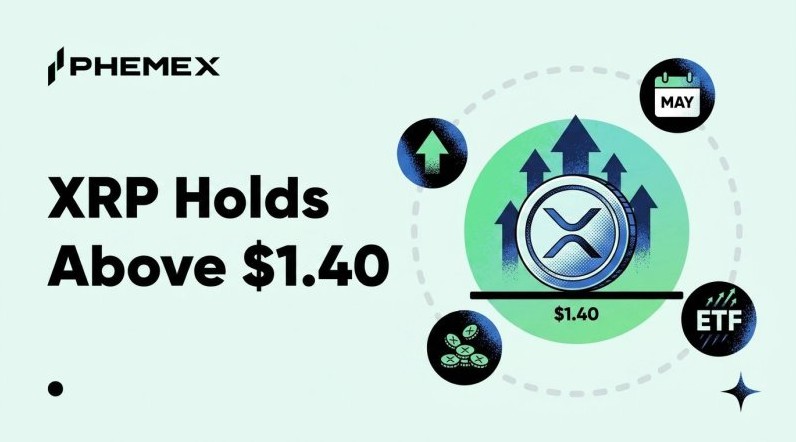
A market analysis reported that XRP closed at approximately $1.42, above the $1.40 level after trading as low as $1.32 during the middle of the month. The analysis described seven spot XRP ETFs launched since late 2025. Together, the products held approximately $1.2 billion in assets under management. Cumulative inflows across the issuer set were approximately $1.44 billion. Net inflows during the month were approximately $84 million, the strongest monthly figure at that point.
The issuer breakdown was presented as follows:
XRP ETF issuers
- Lead issuer: approximately $410 million in AUM and $28 million in net flow
- Second-largest issuer: approximately $245 million in AUM and $19 million in net flow
- Third issuer: approximately $180 million in AUM and $14 million in net flow
- Fourth issuer: approximately $135 million in AUM and $9 million in net flow
- Fifth issuer: approximately $95 million in AUM and $7 million in net flow
- Sixth issuer: approximately $80 million in AUM and $4 million in net flow
- Seventh issuer: approximately $55 million in AUM and $3 million in net flow
All seven products reportedly had net inflows during the month. The analysis characterized the combined XRP ETF complex as larger than the initial Ethereum ETF complex at a comparable point in its launch cycle. It interpreted this as evidence of institutional demand, although the comparison is presented as part of the market analysis.
The month's price action showed XRP testing the $1.32 level twice. Both tests held, and the token rebounded through approximately $1.36 before reclaiming $1.40. The analysis described $1.32 as a "structural floor" and $1.40 as a defended month-end level. Those are interpretations of the price and flow data rather than guarantees of future support.
ETF flows accelerated during the second half of the month even while spot pricing remained volatile. The source interpreted this as institutional buying that was less dependent on short-term price movements. It described the combination of ETF demand, regulatory progress, and Ripple's institutional deal activity as a potential source of relative strength during broader crypto-market weakness.
The near-term catalyst list in the analysis included a full Senate vote on the CLARITY Act, additional spot XRP ETF filings or launches, new Ripple CBDC and cross-border settlement announcements, and continued development of Ripple's institutional payment partnerships.
The analysis described several possible outcomes: if the regulatory vote passes, new ETF issuers enter, and Ripple announces important deals, XRP could be repriced above its then-current range. If none of those catalysts occur, XRP could remain in the current range and retest the $1.32 level. If the regulatory and ETF catalysts occur while the month's inflow pace continues, the stated upside scenario was approximately $1.65 to $1.80. If XRP breaks below $1.32 during a deeper Bitcoin-related decline, the stated downside scenario included a move toward $1.20. These figures were conditional market scenarios, not guaranteed price targets.
The analysis identified two principal risks. The first was regulatory reversal or delay. If the CLARITY Act did not advance, XRP would remain dependent on an executive-action classification that a future administration could modify. The source described this as a low-probability tail risk in the then-current political environment, not a zero risk. The second risk was macro correlation. XRP had shown elevated correlation with Bitcoin during macro weakness. A deeper Bitcoin drawdown could pull XRP below $1.32 even if the regulatory and institutional setup remained intact. A nine-day streak of Bitcoin ETF outflows was identified as an immediate macro risk indicator.
The analysis stated that its structural setup supported the $1.40 to $1.42 area at the time, while also identifying $1.32 as the line that would invalidate the stated floor. It presented defined-risk position sizing above that level as its risk-management approach and warned against chasing either direction.
The SEC lawsuit against Ripple
In December 2020, the U.S. Securities and Exchange Commission sued Ripple Labs, alleging that Ripple had sold XRP as an unregistered security. The dispute focused significantly on the circumstances of Ripple's sales, including the type of buyer, the written contracts involved, and whether buyers expected profits from Ripple's efforts.
Judge Analisa Torres of the United States District Court for the Southern District of New York issued a summary-judgment ruling in July 2023. The decision emphasized that the Securities Act applies to a "contract, transaction[,] or scheme" rather than treating every commodity or digital token as an investment contract by definition.
"XRP, as a digital token, is not in and of itself a 'contract, transaction[,] or scheme' that embodies the Howey requirements of an investment contract."
The court applied the Howey test to Ripple's sales. The test considers whether an investor invested money, whether the investor expected a return of profits, and whether those profits were expected solely from the efforts of a promoter or third party.
The judge found that Ripple's institutional sales satisfied all three requirements and constituted unregistered investment-contract sales. Those sales were conducted under written contracts and involved institutional buyers who were aware of Ripple's marketing and public statements connecting XRP's value to Ripple's products and business efforts.
The ruling reached a different conclusion for Ripple's programmatic sales through cryptocurrency exchanges. The court found that the buyers were not aware that they were buying XRP directly from Ripple and that Ripple had not made promises or offers to those buyers. The third Howey prong was therefore not satisfied in the court's analysis of those transactions.
A November 2025 explainer characterized the July 2023 decision as meaning that XRP was a security in the context of Ripple's institutional sales but was not a security when sold through exchanges to regular users. That summary is broader than the more precise procedural discussion in the FinReg source.
The FinReg source specifically noted that the court's footnote 16 did not decide the status of secondary-market sales of XRP. It stated: "The Court does not address whether secondary market sales of XRP constitute offers and sales of investment contracts because that question is not properly before the Court. Whether a secondary market sale constitutes an offer or sale of an investment contract would depend on the totality of circumstances and the economic reality of that specific contract, transaction, or scheme." That caveat is important. The court analyzed Ripple's programmatic sales to exchange buyers, but it did not fully resolve every question about independent secondary trading in which an exchange or another buyer sells XRP to a purchaser.
Why the legal distinction matters
The Ripple and XRP litigation is consistent with the broader company-token distinction. The SEC case did not treat every transaction involving the same token as automatically identical. It examined who sold XRP, who bought it, what representations were made, and how the buyer expected to receive value.
A person buying XRP on a crypto exchange is buying the token from the exchange or another seller. A person buying Ripple company shares would be buying an equity interest in Ripple. The legal treatment of the company, its corporate communications, institutional contracts, and the token can therefore differ.
The source materials also state that Ripple the company faces its own regulatory pressures, while XRP traded through exchanges is treated more like other crypto assets in some contexts. That description is jurisdiction- and transaction-specific. It does not mean that XRP has one permanent legal classification in every country or every distribution channel.
Regulatory uncertainty and commentary
Lee Reiners's July 2023 FinReg analysis argued that the ruling created a difficult distinction between sophisticated institutional investors and retail investors. His view was that institutional buyers had access to contracts and information that could support securities-law protections, while retail exchange buyers did not receive the same treatment.
The author raised several concerns: securities laws were created in part to protect retail investors from companies raising money without adequate disclosure. Institutional XRP buyers were found to have relied on Ripple's marketing and public statements, while retail buyers were treated as less likely to have relied on the same information. Retail buyers who purchased XRP in expectation of price appreciation could be treated differently even though the author argued that they were still economically relying on Ripple's work and the token's ecosystem.
The author expressed the view that the Second Circuit might reverse Judge Torres's ruling if the SEC appealed. The article also emphasized that the ruling did not establish a single, universal answer for every token or every transaction. Different federal judges could reach different conclusions when applying securities law to similar facts.
The commentary noted that SEC Chairman Gary Gensler had said most tokens were securities, while conceding that Bitcoin was a commodity. The Ripple decision was presented as evidence that the legal boundary was less clear than the SEC's broad position suggested.
The source also discussed the regulatory structure at the time. It stated that the Commodity Futures Trading Commission regulated commodity derivatives but did not regulate commodity spot markets. It therefore described U.S. cryptocurrency exchanges as lacking a comprehensive federal spot-market regulator at that time.
CLARITY Act and commodity classification
A market analysis stated that the CLARITY Act had passed the Senate Banking Committee by a vote of 15-9. At that point, the bill still needed a full Senate vote and would then proceed to the House. The analysis expected a full Senate vote within four to six weeks, although it acknowledged that the timing depended on the broader legislative calendar.
The market analysis described the CLARITY Act as potentially creating a more durable statutory framework for digital-commodity classification. It stated that the SEC and CFTC had issued a joint rule in March and that XRP had been included in a March 17 joint rule.
The analysis argued that the proposed legislation could affect XRP in three ways:
CLARITY Act potential effects
- Permanent commodity status - writing XRP's commodity classification into statute rather than leaving it dependent on executive action
- Secondary-market rules - establishing clearer rules for secondary trading of digital commodities
- Institutional access - reducing compliance friction for institutional allocators
The classification was not yet permanent in the source's description. The analysis presented permanent status as a potential result if the legislation advanced through the remaining stages.
The analysis described the full Senate vote as a major catalyst. A successful vote would move the bill to the House and increase the stated probability of enactment. A failed or delayed vote would leave the legal framework unchanged and could prevent the market from repricing the proposed regulatory clarity.
Crypto liquidity and cross-border settlement
Crypto liquidity refers to how easily a cryptocurrency can be bought or sold without materially changing its market price. High liquidity generally means that a market has many buyers and sellers and can absorb transactions with relatively small price changes. Low liquidity can produce greater volatility, wider spreads, and higher transaction costs.
Liquidity is important for cross-border payments because a payment may need to be converted from a digital asset into the destination country's fiat currency or into another cryptocurrency. If sufficient liquidity is not available at the time of settlement, the conversion may be delayed, become more expensive, or fail.
Traditional cross-border payment systems have improved in speed and reliability, but the source identified several continuing problems: users may not know where a payment is during settlement, transfers can be delayed outside banking hours weekends and holidays, intermediaries may not be available to settle a transaction at all times, correspondent-bank and legacy payment systems can involve multiple participants, currency conversion and intermediary fees can increase costs, and traditional settlement can take days even when the payment instructions are sent quickly.
Blockchain-based payments are presented as an alternative because they can settle near-instantly and are not limited to traditional banking hours or holidays. They can also reduce the number of intermediaries. Blockchain records provide a shared transaction ledger, and transfers can take place at any time.
Ripple's July 2024 liquidity explanation said the company had expanded its payment network across more than 80 payout markets and was building liquidity pathways to make cross-border payments faster, more affordable, and more reliable. The company's stated goal was to provide fast, on-demand settlement at the lowest possible cost while maintaining liquidity outside normal banking hours.
Ripple described three elements of its liquidity strategy: expanding the network, using artificial intelligence and machine learning to determine efficient transaction paths, and improving payment success with a goal of achieving a 100% payment success rate. The company said it was investing in additional global liquidity and expanding payout capabilities in more than 80 countries.
Crypto liquidity is supplied by retail and institutional market participants. Its availability can vary by exchange, trading pair, currency, time of day, and market conditions. The source identified several factors that can reduce liquidity: crypto-to-fiat markets may have less liquidity than fiat-to-fiat markets, emerging-market currencies can have thinner order books, liquidity can be lower on weekends than on weekdays, macroeconomic events can change investor sentiment interest rates currency values and regulatory expectations, and high trading volume can create wider spreads and unexpected transaction costs.
Ripple's liquidity model is primarily a corporate payment-network model. XRP's role in the XRP ecosystem is related but distinct: XRP is intended to serve as a bridge asset and settlement unit, while Ripple's corporate payment network uses exchanges, payout partners, and liquidity providers to support customer transactions.
Historical comparison between XRP and Litecoin
An April 2024 comparison by Priya Bansal described XRP and Litecoin as cryptocurrencies with different primary use cases. The article's market statistics were expressly dated February 2021, so they should not be treated as current prices or rankings.
The comparison described XRP as a cryptocurrency associated with Ripple's cross-border payment network. It described Litecoin as a peer-to-peer digital currency designed for domestic and international payments and for use with banks, merchants, and individuals. It also noted that Litecoin was initially conceived as a Bitcoin spinoff and was designed to be faster and capable of handling more transactions than Bitcoin.
The historical table gave the following values: XRP was established in 2012; Litecoin was established in 2011. XRP used the Ripple Protocol Consensus Algorithm, while Litecoin used Script. XRP had a stated market capitalization of $96.38 billion; Litecoin had $14.03 billion. XRP ranked seventh by market capitalization; Litecoin ranked seventeenth. XRP had a stated year-to-date return of 340%; Litecoin had a stated year-to-date return of 63.16%. XRP was categorized as having an international scope, while Litecoin was categorized as serving domestic and international use. XRP was described as requiring low maintenance, while Litecoin was described as requiring high maintenance. XRP was not mined; Litecoin was mined. The source listed a maximum of 100 billion XRP and 84 million Litecoins.
The comparison also stated that XRP transactions could be sent in as little as three seconds and that XRP and Litecoin were both fixed-supply assets. It described both cryptocurrencies as "deflationary" because the available number of tokens would eventually be capped. The article's investment comparison was not presented as a definitive recommendation. It stated that XRP's cross-border and institutional focus might appeal to someone interested in payment innovation and financial institutions, while Litecoin's broader use case might appeal to someone interested in everyday payments trading or a cryptocurrency modeled partly after Bitcoin. It said there was no clear answer and that both assets had advantages and disadvantages.
The legal discussion in the article warned prospective XRP buyers to monitor the Ripple-SEC litigation. The article also advised that XRP and Litecoin could be held in hardware wallets, software wallets, or exchange wallets and that wallet security was important.
Factors that can affect Ripple equity and XRP
Ripple equity and XRP respond to related but different factors.
Factors affecting each asset
- Institutional adoption - Ripple's adoption by banks and payment providers can affect the company's commercial prospects and influence demand for XRP if Ripple products use the token for settlement
- Regulatory classification - regulatory decisions concerning Ripple's sales, XRP's secondary trading, and the classification of digital assets can affect both the company and the token
- Market sentiment - XRP is exposed to crypto-market sentiment, exchange trading, media coverage, and broader risk appetite
- Technological development - XRP Ledger upgrades, maintenance amendments, security testing, scalability improvements, and transaction-cost changes can affect the perceived usefulness of the network
- Competition - banks, fintech companies, stablecoin networks, other blockchain systems, and traditional payment providers can compete with Ripple for cross-border payment business
- Macro conditions - interest rates, currency values, economic growth, geopolitical events, and Bitcoin's direction can affect XRP
- Custody and operational risk - XRP holders face risks related to exchanges, wallets, bridges, private keys, smart contracts, and custody arrangements
Risk disclosures
Private-company investments carry inherent risks and may not be suitable for all investors. Private Ripple investments may be limited to accredited investors or qualified purchasers and may be subject to offering restrictions, documentation requirements, and private-market procedures.
Cryptocurrency prices are volatile. XRP can rise or fall sharply, and the value of an investment can go down as well as up. The original investment may not be recoverable. Legal outcomes, regulatory decisions, market liquidity, technological failures, exchange operations, and macroeconomic events can all affect the price.
The source materials state that Ripple's private-company stock and XRP should be evaluated differently. A person considering Ripple company equity is evaluating a private corporate investment. A person considering XRP is evaluating a crypto asset, its ledger, its supply, its use cases, its liquidity, and its legal treatment. Buying XRP does not provide Ripple stock, company ownership, or a share of Ripple's earnings.
The distinction between Ripple stock and XRP is not just technical - it affects how you assess risk, what legal protections you have, and what you actually own when you buy.
If you're looking at the market of cryptocurrency and trying to figure out where XRP fits, keep in mind that the token and the company are separate assets with separate risk profiles. The Top 10 crypto stocks lists you see online may mix these up, so always check whether you're looking at company equity or a crypto token.
For people wondering how to buy crypto token like XRP, the process is straightforward on most exchanges - pick the asset, choose your fiat currency, enter the amount, provide payment details, and receive the tokens in a wallet. But if you want exposure to Ripple the company, that's a different path involving private-market investments with their own eligibility requirements and risks.
A safe way to buy crypto starts with using reputable exchanges and secure wallets. The source materials repeatedly emphasize that investors should conduct their own research and use secure, reputable services. Hardware, software, and exchange wallets have different custody and security arrangements, so the token is not automatically protected merely by being held on a platform.
If you're comparing this to how to buy cheap crypto or thinking about a bit coin trade as a starting point, remember that XRP's price can be volatile and its legal status has been the subject of ongoing dispute. The CLARITY Act and other regulatory developments could change the landscape, but nothing is settled yet.
Some people ask is pi crypto worth anything - that's a different question from the Ripple/XRP distinction, but it highlights the same issue: not every token with a famous name backing it is the same as owning equity in the company. Do your homework before putting money into either Ripple shares or XRP tokens.
The how to make your own crypto currency topic is separate from buying XRP, but it underscores a point worth remembering: the XRP Ledger is open-source and can be used by anyone, yet that doesn't give you ownership in Ripple. The tech and the company are distinct, and your investment should reflect that difference.
If you're based in the US and wondering about binance united states availability for XRP, note that some U.S. exchanges have delisted XRP during the SEC lawsuit period. The CLARITY Act was presented as a possible way to reduce that ambiguity, but as of the source materials the legal framework remains unsettled.
When people search for stocks crypto they often expect to find company shares, but the crypto market doesn't always make that distinction clear. XRP trades on exchanges alongside thousands of other tokens, while Ripple equity - if it becomes available - would be a private-market investment with different rules, different risks, and different potential returns.


Comments on “Can You Buy Ripple Stock? XRP Cryptocurrency vs Company Equity”
No comments yet. Be the first to share your thoughts.